Skip to content

What Is Green Seal Certified? The Safe and Smart Way to Choose Cleaning Products

Why Sustainability Matters More Than Ever
Green Seal certification is an independent certification that identifies cleaning products meeting rigorous standards for health, environmental responsibility, and cleaning performance. If you’re looking for safer cleaning products for your home, it’s one of the most trusted labels you can look for.
With so many products labeled “green,” “natural,” or “eco-friendly,” it can be difficult to know which claims are backed by independent testing and which are simply marketing. Green Seal helps remove that uncertainty by evaluating products against science-based standards before they earn certification.
Understanding what Green Seal certifiction means can help you shop with greater confidence, especially when you’re trying to reduce your family’s exposure to harsh chemicals, improve indoor air quality, or make more environmentally responsible purchasing decisions.
In this article, we will explain what is Green Seal certified, how it works, and why it matters when choosing cleaning products for your home. You will also learn how to recognize certified products and make more informed, eco-friendly choices in your everyday cleaning routine.
Table of Contents
Jovany Explains: What is Green Seal Certified
What Is Green Seal Certification?
Green Seal is an independent nonprofit organization that develops science-based environmental standards and certifies products that meet strict requirements for health, sustainability, and performance. Since its founding in 1989, Green Seal has helped consumers and organizations identify products that clean effectively while reducing unnecessary risks to people and the environment.
When a cleaning product carries the Green Seal Certified mark, it has undergone an independent review rather than relying solely on the manufacturer’s marketing claims. Certification is awarded only after the product demonstrates that it meets Green Seal’s published standards for ingredients, performance, environmental impact, and product safety.
Unlike terms such as “green,” “natural,” or “eco-friendly,” which often have no standardized definition, Green Seal certification is based on transparent criteria that manufacturers must satisfy before earning the certification.
Certification is also not permanent. Manufacturers must continue meeting Green Seal’s requirements through ongoing compliance and periodic reviews, helping ensure certified products continue to meet the standards consumers expect.
For homeowners, that means the certification serves as a reliable shortcut when comparing cleaning products. Instead of researching every ingredient individually, you can look for the Green Seal logo as evidence that an independent organization has already evaluated the product against established environmental and performance criteria.
How Does Green Seal Certification Work?
Green Seal evaluates products using a life-cycle approach rather than focusing on a single characteristic. This means certification considers how a product affects people and the environment throughout its entire lifecycle, from ingredient selection and manufacturing to packaging, use, and disposal.
While specific requirements vary depending on the product category, certification generally includes evaluations such as:
- Ingredient safety
- Human health considerations
- Cleaning effectiveness
- Environmental impact
- Volatile organic compound (VOC) limits
- Biodegradability
- Packaging sustainability
- Product labeling and transparency
Manufacturers must provide extensive documentation, undergo independent review, and demonstrate that their products perform as well as or better than conventional alternatives while meeting Green Seal’s environmental and health standards.
Why Green Seal Matters for Homeowners
For many homeowners, choosing a cleaning product isn’t just about removing dirt or making surfaces shine. It’s also about creating a healthier indoor environment while avoiding unnecessary exposure to harsh chemicals.
Green Seal certification helps simplify that decision.
Instead of trying to interpret long ingredient lists or relying on marketing language, you can choose products that have already been independently evaluated against recognized environmental and health criteria.
Here are several reasons homeowners often look for Green Seal-certified products.
Better Indoor Air Quality
Many conventional cleaning products contain volatile organic compounds (VOCs), fragrances, or solvents that can contribute to indoor air pollution.
Green Seal standards place limits on VOC content and other ingredients associated with unnecessary indoor air emissions. While no cleaning product is completely free of risk, certified products are designed to reduce avoidable chemical exposure while still providing effective cleaning performance.
For households with children, older adults, pets, or individuals sensitive to strong fragrances or airborne irritants, choosing lower-emission cleaning products may contribute to a more comfortable indoor environment.
Greater Confidence in Product Claims
Many products advertise themselves as “green,” “natural,” or “environmentally friendly.” Unfortunately, those terms are often used without consistent definitions or independent verification.
Green Seal certification provides third-party validation.
Instead of relying solely on advertising claims, consumers can look for certification from an independent nonprofit organization that publishes transparent standards and verifies compliance before allowing products to display its certification mark.
This helps reduce the confusion caused by greenwashing, where products appear environmentally friendly without meaningful evidence to support those claims.
Support for More Sustainable Manufacturing
Green Seal evaluates more than the ingredients inside a bottle.
Its certification standards also consider factors such as manufacturing practices, packaging, waste reduction, and the overall environmental impact of the product throughout its lifecycle.
Choosing certified products supports manufacturers that invest in reducing pollution, improving resource efficiency, and designing products with long-term environmental considerations in mind.
While one purchase may seem small, widespread adoption of independently certified products encourages higher industry standards across the cleaning product market.
A Smarter Long-Term Buying Strategy
Many homeowners eventually discover that building a safer cleaning routine isn’t about replacing every product overnight.
Instead, Green Seal certification offers a practical way to make better purchasing decisions over time.
As you replace empty bottles or try new cleaning products, looking for trusted third-party certifications can help you gradually build a cleaning cabinet with products that align with your health, performance, and environmental priorities.
Rather than chasing every new “green” label that appears on store shelves, Green Seal gives you a consistent benchmark you can rely on.
What Does Green Seal Actually Test?
Many people assume Green Seal certification simply means a product is “natural” or made with plant-based ingredients. In reality, the certification process is much more comprehensive.
Green Seal evaluates cleaning products against multiple criteria to ensure they perform well while minimizing unnecessary risks to people and the environment. The exact requirements vary depending on the product category, but certification generally includes the following areas.
Ingredient Safety
Green Seal reviews product ingredients to reduce unnecessary health and environmental risks.
Products may be restricted from containing ingredients associated with:
- High toxicity
- Certain carcinogens
- Reproductive toxins
- Persistent environmental pollutants
Why it matters: Instead of relying on marketing claims, you can feel more confident that an independent organization has reviewed the product’s formulation.
Cleaning Performance
A safer cleaner still needs to do its job. To earn certification, products must demonstrate they can effectively clean the surfaces they’re designed for.
That means certification isn’t awarded simply because a product is environmentally friendly. It also has to perform well.
Why it matters: You don’t have to sacrifice cleaning power to choose a more sustainable product.
Indoor Air Quality
Some cleaning products release volatile organic compounds (VOCs), which can affect indoor air quality. Green Seal standards place limits on VOC emissions for many product categories.
This may help reduce exposure to unnecessary airborne chemicals, especially in homes with:
- Children
- Older adults
- Pets
- People sensitive to strong fragrances
Why it matters: Cleaner indoor air can make your home more comfortable, particularly if someone in your household is sensitive to strong chemical odors or spends a lot of time indoors.
Packaging and Sustainability
Packaging also plays a role in certification.
Green Seal encourages manufacturers to:
- Reduce unnecessary packaging
- Improve recyclability
- Minimize waste where practical
While packaging alone won’t earn certification, it’s part of the overall environmental assessment.
Why it matters: Choosing products with more sustainable packaging helps reduce waste over time and supports manufacturers that prioritize environmentally responsible practices beyond the cleaner itself.
Ongoing Compliance
Green Seal certification isn’t a one-time achievement. Manufacturers must continue meeting certification requirements through ongoing reviews and compliance monitoring.
Why it matters: The certification provides more confidence than labels based solely on manufacturer claims.
At a Glance: What Green Seal Evaluates
| Evaluation Area | Why It Matters to Homeowners |
|---|---|
| Ingredient safety | Helps reduce unnecessary exposure to higher-risk chemicals |
| Cleaning performance | Confirms the product works as intended |
| Indoor air quality | Encourages lower VOC emissions where applicable |
| Environmental impact | Considers the product’s lifecycle, not just one feature |
| Packaging | Promotes more sustainable packaging practices |
| Ongoing compliance | Provides continued third-party oversight |
Green Seal vs. Other Cleaning Certifications
Not all eco-labels evaluate cleaning products the same way. Some focus on ingredient safety, while others emphasize environmental impact or renewable materials.
Here’s a quick comparison of the most common certifications you’ll encounter when shopping for household cleaning products.
| Certification | What It Focuses On | Best For | Third-Party Verified? |
|---|---|---|---|
| Green Seal | Cleaning performance, ingredient safety, environmental impact, packaging, and sustainability | Homeowners looking for well-rounded, independently certified cleaning products | ✅ Yes |
| EPA Safer Choice | Safer chemical ingredients and human health considerations | Consumers who want products made with safer chemical ingredients | ✅ Yes |
| UL ECOLOGO | Environmental performance throughout a product’s lifecycle | Buyers comparing environmentally preferable products | ✅ Yes |
| USDA BioPreferred | Percentage of renewable, bio-based ingredients | Consumers looking for products made from renewable materials | ✅ Yes |
Green Seal vs. EPA Safer Choice
These are two of the most recognized certifications for household cleaning products, but they focus on different aspects of product evaluation.
Green Seal evaluates products using a broad life-cycle approach that considers ingredient safety, cleaning performance, environmental impact, packaging, and sustainability.
EPA Safer Choice focuses primarily on the safety of chemical ingredients. Products displaying the EPA Safer Choice label contain ingredients that the EPA has reviewed for human health and environmental characteristics while still meeting performance expectations.
Rather than viewing the certifications as competitors, many consumers see them as complementary. Some products even carry both certifications.
Green Seal vs. EcoLogo
EcoLogo, now part of UL Solutions, also certifies environmentally preferable products.
Like Green Seal, EcoLogo evaluates products using environmental standards and third-party certification.
While there is overlap between the programs, each organization develops its own standards, certification requirements, and testing methodologies.
Green Seal vs. USDA BioPreferred
USDA BioPreferred measures something entirely different.
Instead of evaluating overall environmental performance, BioPreferred identifies products containing renewable biological ingredients derived from plants, animals, marine sources, or forestry materials.
A product may qualify for BioPreferred because of its renewable ingredients without necessarily meeting the broader environmental and performance criteria required for Green Seal certification.
Which Certification Should You Trust?
If you’re shopping for everyday household cleaners, Green Seal is one of the easiest certifications to trust because it balances:
- Cleaning performance
- Safer ingredients
- Environmental responsibility
- Independent third-party verification
If you find a product with both Green Seal and EPA Safer Choice, that’s often an excellent choice for homeowners who want a balance of effectiveness and responsible product formulation.
How to Identify Green Seal Certified Cleaning Products
Finding Green Seal-certified products is easier than you might think. Once you know what to look for, you can quickly separate independently certified products from those making unverified environmental claims.
Look for the Green Seal Certified Logo
The easiest way to identify a certified product is by looking for the official Green Seal certification mark on the packaging.
You’ll typically find it:
- On the front label
- Near the product description
- On the back of the bottle
- In the product specifications for online listings
The logo indicates the product has met Green Seal’s published certification standards through an independent review process.
Verify the Product Online
If you’re unsure whether a product is currently certified, you can verify it using Green Seal’s online directory.
The directory allows you to search by:
- Brand
- Product name
- Product category
- Certification standard
Because certifications are periodically reviewed, checking the directory helps ensure a product still maintains its certification.
Read Beyond the Marketing Claims
Many cleaning products advertise themselves as “natural”, “eco-friendly”, “non-toxic”, or “sustainable”.
While those descriptions may be accurate, they aren’t certifications.
Instead of relying solely on marketing language, look for independent certifications like Green Seal to verify that a product has been evaluated against established standards.
Buy from Trusted Retailers
Green Seal-certified products are available through many major retailers, including grocery stores, home improvement stores, office supply stores, and online marketplaces.
If you’re shopping online, filtering products by certification or checking product specifications can make finding certified options easier.
How to Transition to Green Seal Certified Cleaning Products
You don’t have to replace every cleaning product in your home overnight.
In fact, making small, intentional changes is often the smarter approach. As you finish the products you already own, you can gradually replace them with Green Seal-certified alternatives that better align with your health and sustainability goals.
Replace Products as You Run Out
Instead of throwing away perfectly usable cleaners, replace them with Green Seal-certified alternatives when they’re empty.
Start with products you use most often, such as:
- All-purpose cleaners
- Kitchen cleaners
- Bathroom cleaners
- Glass cleaners
This approach reduces waste while making it easier to build a more sustainable cleaning routine over time.
Prioritize Frequently Used Products
Some cleaners are used almost every day.
Replacing these products first can have the biggest impact on your household.
Choose the Right Product for the Job
Even the best-certified cleaner won’t work well if it’s used on the wrong surface.
Always choose products designed for the material you’re cleaning and follow the manufacturer’s instructions.
For example:
- Glass cleaners for mirrors and windows
- Floor cleaners for finished flooring
- Bathroom cleaners for soap scum and hard water buildup
- All-purpose cleaners for everyday washable surfaces
Look Beyond One Certification
Green Seal is an excellent indicator of product quality, but it shouldn’t be the only factor you consider.
Before purchasing a cleaner, also think about:
- The surfaces you’ll be cleaning
- Fragrance preferences
- Household sensitivities
- Product instructions
- Compatibility with your cleaning routine
The best cleaning product is the one that’s appropriate for your home, your surfaces, and your family’s needs.
At Roochii Cleaning, this is the same approach we take when choosing products for our clients’ homes. We use Green Seal-certified cleaning products whenever possible because they meet high standards for performance and environmental responsibility.
However, certification is only part of the decision. We also select products based on the surface being cleaned, the type of soil, and the manufacturer’s recommendations to help protect your home while delivering excellent cleaning results.
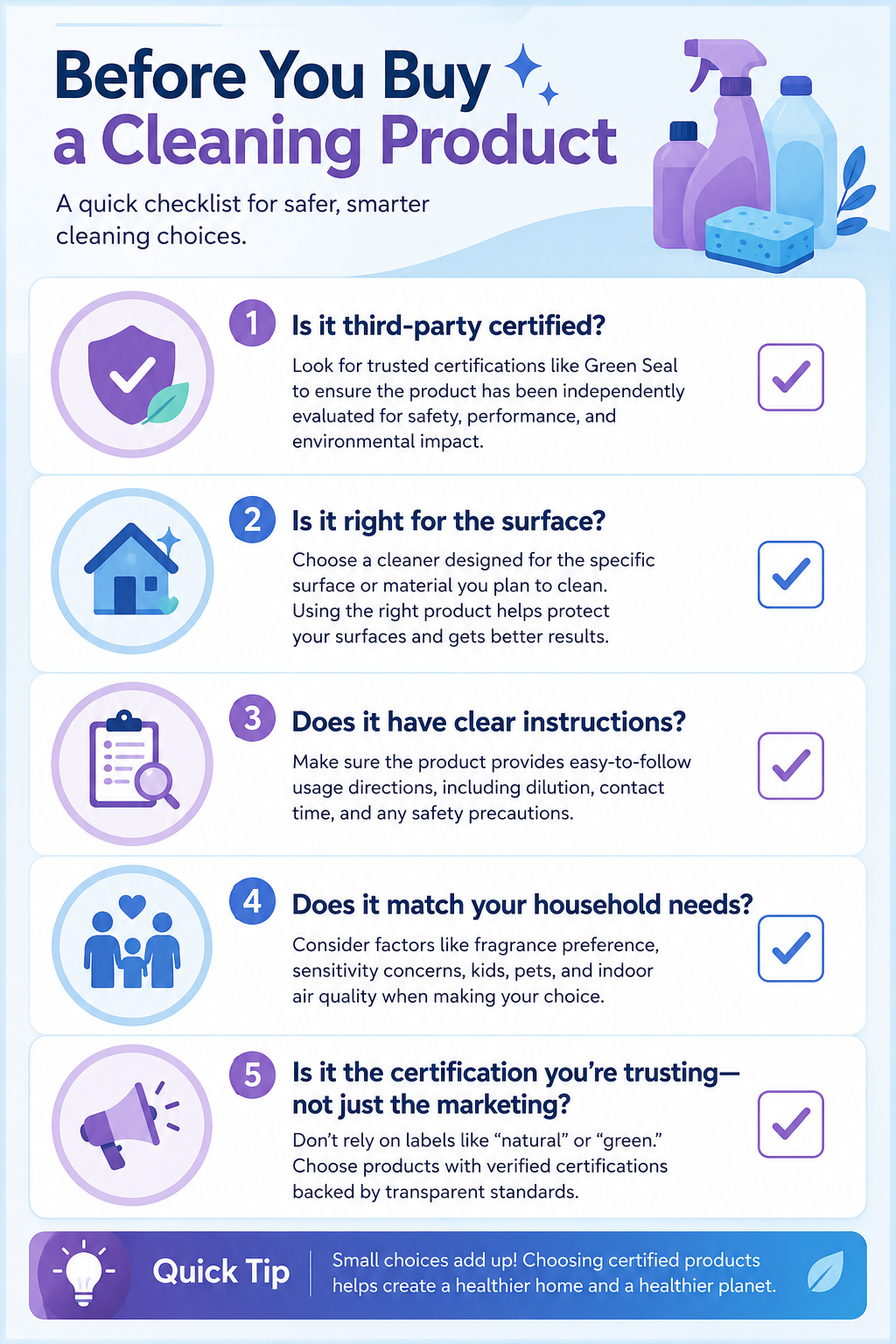
Quick Checklist Before Buying a Cleaning Product
Before adding a cleaner to your cart, ask yourself:
- Does it display a trusted third-party certification?
- Is it designed for the surfaces I plan to clean?
- Does it provide clear usage instructions?
- Does it match my household’s preferences, such as fragrance-free or low-VOC options?
- Am I choosing it because of verified certification rather than marketing claims alone?
If you answered “yes” to most of these questions, you’re likely making a well-informed purchasing decision.
Final Note: Why Green Seal Certification Is Worth Looking For
Choosing cleaning products can feel overwhelming when nearly every bottle claims to be “green,” “natural,” or “eco-friendly.” Green Seal certification helps cut through that marketing by identifying products that have been independently evaluated for cleaning performance, health considerations, and environmental responsibility.
While no certification should replace reading product labels or following manufacturer instructions, Green Seal provides a reliable starting point for homeowners who want to make more informed purchasing decisions.
As you replace the cleaning products you already use, looking for trusted third-party certifications like Green Seal can help you build a cleaning routine that’s effective, practical, and aligned with your health and sustainability goals.
FAQ
Green Seal Certified Cleaning Questions
Yes. Green Seal-certified products are tested to meet high standards for cleaning performance. They are required to work just as well as traditional cleaners, ensuring that you do not have to compromise effectiveness when choosing safer, greener options.
Yes. These products are formulated without harsh chemicals that can irritate sensitive skin, lungs, or eyes. That makes them a safer choice for families with young children, older adults, or pets who spend a lot of time on cleaned surfaces.
Some certified products may cost slightly more upfront, but many are competitively priced. Over time, the benefits — fewer health risks, safer usage, and longer-lasting surfaces — often outweigh the minor price difference.
Green Seal certifies a wide range of cleaning products, including all-purpose cleaners, disinfectants, bathroom and kitchen cleaners, floor care solutions, hand soaps, and laundry detergents. You can find them online, in grocery stores, and through eco-focused retailers.
Yes. Green Seal is an independent nonprofit organization that has certified products since 1989. Unlike marketing terms such as "green" or "eco-friendly," Green Seal certification requires products to meet published standards for performance, health, and environmental responsibility through a third-party review process.
Neither certification is universally "better." They simply evaluate different aspects of a product.
Green Seal takes a broader approach by considering cleaning performance, ingredient safety, environmental impact, packaging, and sustainability. EPA Safer Choice focuses primarily on the safety of a product's chemical ingredients.
Some can, but certification alone doesn't guarantee disinfecting capabilities.
If you need to kill bacteria or viruses, look for products specifically labeled as disinfectants and follow the manufacturer's directions for contact time and proper use.
Green Seal certification focuses on environmental and health standards, while disinfecting claims are regulated separately.