Skip to content

Bleach or Vinegar for Mold: Which Is Better?
Bleach vs. Vinegar for Mold Remediation
If you are deciding between bleach and vinegar for mold, the better choice depends less on which cleaner is “stronger” and more on the surface, the amount of mold, and the moisture causing it to grow. For small areas on suitable hard surfaces, cleaning and complete drying are usually more important than trying to sterilize the surface.
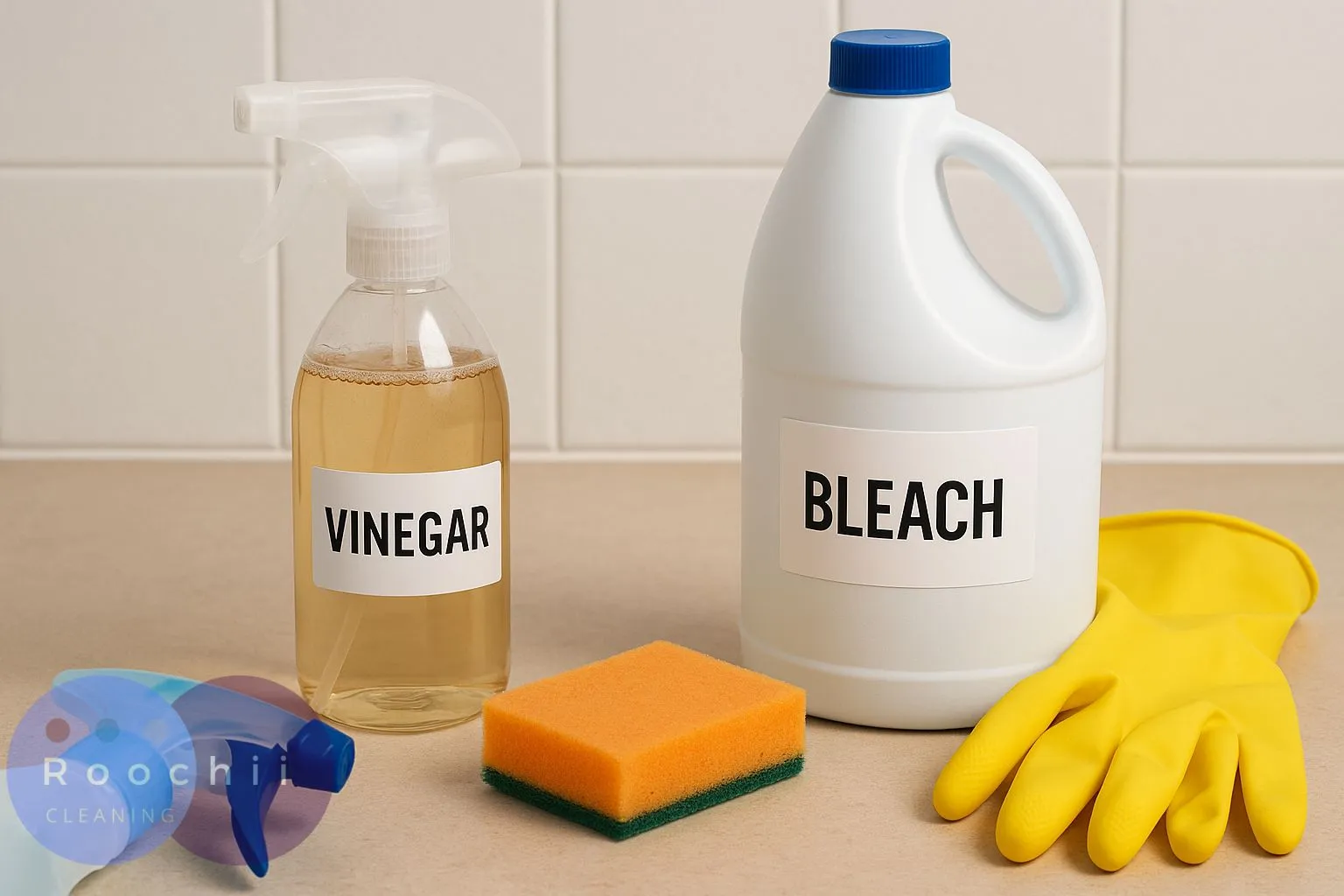
Bleach and vinegar are also very different products. Bleach is a chlorine-based oxidizing cleaner and disinfectant containing sodium hypochlorite. Vinegar is an acidic cleaner containing acetic acid.
Use the wrong product, and you risk a mold encore, unnecessary chemical exposure, or even a dangerous science experiment. For example, mixing bleach and vinegar can release potentially toxic gas that harms your lungs.
In this article, we’ll discuss how bleach and vinegar differ, which surfaces require more caution, why mold keeps returning, what to do if cleaners have already been mixed, and when a mold problem is better handled through professional remediation.
Table of Contents
- Bleach or Vinegar for Mold: What’s the Right Choice?
- The Surface Matters More Than the Cleaner
- Bleach for Mold: What It Can and Can’t Do
- Vinegar for Mold: Where It Helps and Where It Doesn’t
- Why Mold Keeps Coming Back After Cleaning
- Why You Should Never Mix Bleach and Vinegar
- When Is Mold Too Much for a DIY Cleanup?
- How to Keep Mold From Coming Back

Bleach or Vinegar for Mold: What’s the Right Choice?
If you’re looking for one product that wins every mold-cleaning situation, you’re going to be disappointed.
There isn’t one.
Bleach is mainly useful for disinfecting and treating mold on appropriate hard, non-porous surfaces. It does not automatically remove all mold growth or solve the moisture problem behind it.
Vinegar, on the other hand, is an acidic cleaner that can help with some mold growth on surfaces that tolerate acids. It can be useful, but it should not be treated as a universal mold killer.
The better choice depends on the surface, size of the affected area, moisture source, and whether the mold can actually be removed from the material.
For a small amount of mold on an appropriate hard surface, the basic job is:
- Remove the visible growth.
- Clean the surface appropriately.
- Remove residue when appropriate.
- Dry the area completely.
- Fix the moisture problem.
That last step matters more than many people realize.
If a leak or condensation problem is still feeding the mold, switching from vinegar to bleach won’t magically solve it.
Quick Guide When Dealing with Mold
| If you’re dealing with… | Think about… |
|---|---|
| Small mold growth on an appropriate hard, non-porous surface | Physical cleaning plus an appropriate cleaner |
| A surface where disinfection is the main concern | Bleach may be appropriate if the material and product label allow it |
| A small amount of mold on an acid-tolerant surface | Vinegar may help as an acidic cleaner |
| Marble, limestone, travertine, or other acid-sensitive stone | Avoid vinegar |
| Mold in drywall, carpet padding, or other absorbent material | Focus on whether the material can actually be cleaned and dried |
| Mold that keeps returning | Find and correct the moisture source |
| A large or widespread area, significant water damage, or mold embedded in materials | Consider professional assessment |
One rule is non-negotiable: never mix bleach and vinegar. They are different chemical products, and combining bleach with an acid such as vinegar can release chlorine-containing gas.
The Surface Matters More Than the Cleaner
Mold on a bathroom tile is not the same problem as mold inside drywall.
That distinction is important because cleaners work on surfaces, but mold can grow inside materials.

Hard, non-porous surfaces
Examples include:
- Glazed ceramic tile
- Porcelain
- Glass
- Some intact hard plastics
- Certain finished surfaces
These materials are generally easier to clean because the mold is more accessible at the surface.
That does not mean every chemical is automatically safe for every finish. The cleaner, concentration, contact time, and condition of the surface still matter.
Porous materials
Examples include:
- Drywall
- Carpet
- Carpet padding
- Ceiling tile
- Insulation
- Unfinished wood
These materials are more difficult because mold can grow into pores, fibers, and other spaces.
Spraying the surface may change what you can see without completely addressing what is inside the material. That is why repeated chemical treatment is not necessarily the answer for heavily affected porous materials.
Acid-sensitive surfaces
This is where vinegar deserves particular caution.
Avoid treating these materials as routine vinegar-cleaning surfaces:
- Marble
- Limestone
- Travertine
- Other acid-sensitive natural stone
Vinegar contains acetic acid. Acidic cleaners can react with calcium-based stone and dull or etch the surface.
pH also matters because it affects how a cleaner behaves. Vinegar is acidic, while household bleach is strongly alkaline, although the exact pH varies by product formulation and concentration. That difference helps explain why vinegar can damage acid-sensitive stone and why bleach can affect certain finishes, dyes, and materials.
Pro Tip: The more porous, damaged, absorbent, or moisture-affected the material is, the less likely a simple spray-and-wipe approach will solve the problem.
Bleach for Mold: What It Can and Can’t Do
Bleach is mainly useful when you need an oxidizing cleaner or disinfecting product for an appropriate hard, non-porous surface.
Household bleach generally contains sodium hypochlorite, a chlorine-based oxidizing chemical. It can kill or inactivate microorganisms under appropriate conditions, but that does not mean it automatically removes mold from every material.
It may damage or discolor some dyes, coatings, finishes, metals, plastics, and fabrics, and can irritate the skin, eyes, and respiratory system.
In particular, bleach is not a magic fix for mold growing inside porous materials such as drywall, carpet padding, insulation, or unfinished wood.
Never mix bleach with vinegar, ammonia, acids, or other cleaning products.
When bleach may be useful
Bleach may be appropriate for:
- Small areas of mold on suitable hard, non-porous surfaces
- Situations where disinfection is part of the cleaning goal
- Surfaces that the specific bleach product is labeled for
It is not a good reason to reach for bleach simply because the mold looks stubborn.
How to use bleach for mold
For a small area on a surface that the bleach product is intended for:
- Check the surface first. Make sure the material and finish are compatible with the product. Be especially cautious with colored materials, coatings, metals, and surfaces that can be damaged by strong alkaline or oxidizing cleaners.
- Read the bleach product label. Use the dilution, contact time, ventilation instructions, and other directions provided for that specific product. Bleach concentrations and formulations vary, so one universal recipe should not be applied to every product.
- Protect yourself and the surrounding area. Improve ventilation and avoid getting bleach on skin, eyes, clothing, or nearby materials that could be damaged.
- Remove the visible mold and surface debris as appropriate. Chemical treatment should not be treated as a substitute for physically cleaning the affected surface.
- Apply the bleach solution according to the product label. Give it the required contact time rather than immediately wiping it away.
- Wipe or rinse away residue if the product label and surface allow it. Do not assume that leaving chemical residue behind will provide better mold protection.
- Dry the area completely. Moisture is one of the main reasons mold returns.
- Fix the moisture source. Check for leaks, condensation, humidity, poor ventilation, or water intrusion. Otherwise, you may end up cleaning the same spot again.
What bleach cannot guarantee
Bleach cannot guarantee that:
- Mold has been completely removed from a porous material
- A damp wall will stay mold-free
- A recurring moisture problem has been solved
- A stained surface has been restored
- Every surface will tolerate the product without damage
The EPA does not recommend routine use of chlorine bleach for mold cleanup. Its guidance emphasizes physically removing mold from appropriate surfaces and correcting the moisture problem.`

Vinegar for Mold: Where It Helps and Where It Doesn’t
Vinegar is a very different type of cleaner.
Household vinegar contains acetic acid, which makes it acidic. Typical household vinegar is commonly around 4% to 7% acetic acid, depending on the product.
Vinegar may help with some mold growth on suitable, acid-tolerant surfaces, but it should not be treated as a universal mold killer.
Some laboratory research has found antifungal activity from vinegar under specific test conditions. That does not mean the same result will occur on every mold species, material, or real-world building surface.
When vinegar may be useful
Vinegar may be considered for:
- Small amounts of mold on a surface that tolerates acidic cleaners
- Cleaning tasks where an acidic cleaner is appropriate
- Certain hard surfaces where the manufacturer does not prohibit acidic products
But vinegar is not appropriate for every surface.
Avoid using it as a routine mold cleaner on acid-sensitive materials such as:
- Marble
- Limestone
- Travertine
- Other calcium-based natural stone
It can also be unsuitable for certain metal finishes, coatings, sealants, and treated surfaces.
How to use vinegar for mold
For a small amount of mold on a surface that can tolerate vinegar:
- Check the material first. Make sure the surface is compatible with an acidic cleaner. If the manufacturer says to avoid vinegar or acidic products, don’t use it.
- Use plain household vinegar rather than creating a chemical mixture. There is no need to add bleach, ammonia, or another cleaner.
- Apply the vinegar to the affected area. Use enough to wet the area you’re treating without unnecessarily soaking surrounding materials.
- Allow appropriate contact time. If you’re following a product-specific cleaning instruction, use that guidance. Avoid assuming that leaving vinegar on a surface indefinitely will make it more effective.
- Physically clean the surface. Wipe or scrub the affected area as appropriate for the material. The goal is to remove the visible growth and residue, not simply leave mold sitting in vinegar.
- Remove residue when appropriate. Wipe or rinse the surface if the material allows it.
- Dry the area completely. Do not leave the surface damp after cleaning.
- Address the moisture problem. If condensation, leaks, humidity, or another water source remains, mold can return regardless of which cleaner you used.
What vinegar does not guarantee
Vinegar does not guarantee that:
- All mold species will be eliminated
- Mold inside porous materials will be removed
- A moisture problem will be fixed
- A damaged building material will be restored
- Mold will not return
Why Mold Keeps Coming Back After Cleaning
If mold keeps coming back after you’ve cleaned it, the cleaner may not be the real problem.
Mold needs moisture to grow. If the area stays damp, you can clean the same spot over and over without fixing the reason it keeps returning.
One Roochii Cleaning client had mold showing up repeatedly in the same area. Instead of simply treating the visible growth again, we looked at the surrounding area and focused on what could be allowing the moisture to remain. That experience is a good reminder that mold cleaning isn’t just about making the visible growth disappear. If the underlying moisture problem isn’t addressed, the mold can come back no matter which cleaner you use.
Common reasons mold comes back
If mold keeps returning, look for a moisture problem nearby. Common causes include:
- Leaks: Plumbing, roof, window, or appliance leaks can keep a surface or wall damp.
- Condensation: Cold walls, windows, pipes, and air-conditioning areas can collect moisture.
- High humidity: Bathrooms and other poorly ventilated spaces can stay humid enough for mold to grow.
- Poor ventilation: Steam from showers or everyday household activity may not be drying out properly.
- Wet materials: Carpet, padding, drywall, wood, or other materials can hold moisture long after a leak or spill.
- Hidden water: Moisture behind walls, under flooring, or around plumbing can keep feeding mold where you can’t easily see it.
- Incomplete drying: Materials that were not fully dried after a leak, flood, or water damage can remain a source of recurring mold.
Before you clean it again, check the area. Ask yourself these questions:
- Is the surface still damp?
- Is condensation forming there?
- Could water be getting behind the wall or floor?
- Is the bathroom getting enough ventilation?
- Was the material completely dried after the original water problem?
- Is the mold growing into a porous material?
If the moisture problem remains, cleaning the visible mold won’t solve the underlying problem. Fix the water or humidity source first, then clean and dry the affected area. Otherwise, you may just be giving the mold another reason to come back.
Why You Should Never Mix Bleach and Vinegar
Bleach and vinegar should never be used together.
Bleach contains sodium hypochlorite, while vinegar contains acetic acid. When vinegar is added to bleach, the acid changes the bleach chemistry and shifts more of the solution toward hypochlorous acid. Under these acidic conditions, chlorine-containing gases can form.
That is why mixing them is dangerous. You are not simply making a stronger cleaner. The chemicals are reacting and can produce irritating gases that affect the eyes and respiratory system and, at higher exposures, cause serious injury.
Mixing cleaners does not simply combine their cleaning power. They can react and produce different chemicals, some of which may be hazardous.
If you need to use both, use them separately:
- Finish using the first product.
- Wipe or rinse away residue if the surface and product label allow it.
- Let the surface dry completely.
- Only then consider whether a second product is actually needed.
- Never apply one wet product directly over another.
One product at a time is the safest approach.
Already Mixed Bleach and Vinegar? Do This
If you accidentally mixed bleach and vinegar, don’t panic and don’t try to “fix” the mixture with another cleaner.
Do the following steps:
- Stop using the products.
- Leave the area and get into fresh air.
- Keep people and pets away.
- Do not add another chemical.
- If safe, ventilate the area without exposing yourself to fumes.
- Get medical help for serious symptoms.
- Contact your local poison center or emergency service for situation-specific advice.
Get urgent medical attention if someone develops symptoms such as:
- Significant breathing difficulty
- Chest pain
- Severe or persistent coughing
- Serious eye irritation
- Other concerning symptoms after the exposure
If the fumes are strong, don’t stay inside just to finish cleaning. The mold can wait.
When Is Mold Too Much for a DIY Cleanup?
Not every mold spot needs a professional. A small patch on an appropriate hard surface may be manageable with ordinary household cleaning.
The situation changes when the affected area is large, the material is porous, or water damage is involved.
For larger or more difficult cleaning projects, you may want to bring in a professional cleaning service rather than continuing to treat the area yourself.
EPA guidance commonly uses about 10 square feet as a useful threshold for deciding when a mold cleanup may be beyond a simple DIY project.
Consider professional assessment when:
- Mold covers a large area.
- The affected area is around 10 square feet or more.
- There has been extensive water damage.
- Mold appears inside walls or ceilings.
- Insulation is affected.
- Carpet or other porous materials are heavily contaminated.
- HVAC equipment or ductwork may be involved.
- Sewage or contaminated water was involved.
- Mold continues returning after the moisture source has been corrected.
- You cannot determine how far the moisture or mold has spread.
The size of the moldy area is useful, but it isn’t the only consideration. A smaller area can still be complicated if it involves:
Hidden moisture + porous material + recurring growth
That’s very different from a small surface spot on a bathroom tile.
How to Keep Mold From Coming Back
Cleaning removes the mold you can see. Keeping it from coming back means dealing with the moisture that allowed it to grow in the first place.
Start by finding the moisture
Check the area for:
- Plumbing, roof, or window leaks
- Condensation on walls, windows, or pipes
- High indoor humidity
- Poor bathroom or kitchen ventilation
- Wet carpet, drywall, wood, or other building materials
- Water getting behind walls or under flooring
If you find a moisture source, fix it rather than simply cleaning the mold again.
Keep the area dry
Once the source is addressed, help the area dry completely. Depending on the situation, that may mean:
- Improving bathroom or kitchen ventilation
- Using a dehumidifier
- Drying wet materials as soon as possible
- Repairing plumbing, roof, or window leaks
- Replacing porous materials that are too damaged or contaminated to clean properly
If the mold keeps coming back
If mold keeps appearing in the same spot, don’t just keep treating it with more cleaner.
Recurring growth is a sign that something may still be providing moisture, whether it’s a leak, condensation, high humidity, or water trapped inside the material.
Clean the mold you can see, but find and fix the moisture source behind it. Otherwise, you may be cleaning the same patch again and again without solving the reason it keeps coming back.
Final Thoughts
When it comes to bleach or vinegar for mold, neither is the universal answer. Bleach can be useful on appropriate hard, non-porous surfaces, while vinegar may help with some mold on surfaces that tolerate acidic cleaners. The right choice depends on the type of surface, the extent of the mold, and whether the area can be properly cleaned and dried.
More importantly, cleaning the visible mold is only part of the job. If moisture from leaks, condensation, humidity, or wet materials remains, mold can return regardless of which cleaner you use.
And above all, never mix bleach and vinegar. Use cleaning products separately, follow their labels, and address the moisture problem so you’re not stuck cleaning the same patch over and over.
FAQ
FAQs About Vinegar or Bleach for Mold
Neither is universally better. The right approach depends on the surface, amount of mold, moisture source, and whether the material can be properly cleaned and dried.
Vinegar can inhibit some fungi under certain laboratory conditions, but it should not be treated as a universal mold-killing solution.
Bleach can kill or inactivate microorganisms under appropriate conditions, but killing mold is not the same as removing mold from a porous building material.
Don't assume that bleach will solve mold on drywall. Drywall is porous, and extensive or embedded mold may require removal or professional assessment rather than repeated chemical treatment.
It depends on the type and finish of the wood. Vinegar is acidic, so it should not automatically be used on every wood surface. Check the manufacturer's care instructions, especially for finished or treated wood.
No. Vinegar is acidic and can damage acid-sensitive stone such as marble, limestone, and travertine.
We would not recommend the mixture as a stronger mold treatment. Baking soda is mildly alkaline and abrasive, while vinegar is acidic. Their reaction produces fizzing but does not turn the mixture into a universal mold disinfectant.
Leave the area and get into fresh air. Do not add another cleaner. If it is safe to ventilate without exposing yourself to fumes, do so. Seek urgent medical attention for significant breathing difficulty, chest pain, severe coughing, or other serious symptoms.
Usually, something is allowing moisture to remain. Leaks, condensation, high humidity, poor ventilation, and wet porous materials can all contribute to recurring mold.
Consider professional help when mold covers a large area, has affected porous building materials, follows significant water damage, involves HVAC systems, involves contaminated water, or continues returning after the moisture problem has been corrected.