HEPA Filter vs Regular Filter: Key Differences
Which One Should You Trust for Cleaner Air?
If you’re trying to figure out who wins in the battle of HEPA filter vs regular filter, here’s the quick answer: HEPA filters.
Regular filters still have their place, but they’re better suited for basic dust control, not deep air purification.
HEPA filters are like the overachievers of the filtration world: capturing allergens, pet dander, pollen, even bacteria, and leaving very little behind.
Think of HEPA as the vacuum you bring in for allergy season or post-renovation dust storms, and regular filters as your everyday go-to when you’re just trying to keep things generally tidy. Use the wrong one for the wrong job, though, and you could end up wasting energy, time, and even making your indoor air worse
In this blog, we’ll break down:
Understanding the Basics of HEPA and Regular Filters
When you begin thinking about improving indoor air quality or simply making your cleaning routine more effective, the topic of “HEPA filter vs non-HEPA filter” often comes up.
It’s helpful to start with the fundamentals so you know what’s going on behind the scenes.
What is a HEPA filter?
HEPA stands for High Efficiency Particulate Air. According to the U.S. Environmental Protection Agency (EPA), a true HEPA filter is a type of pleated mechanical air filter that can remove at least 99.97 % of airborne particles that are 0.3 microns in diameter, which is considered the “worst‑case” particle size.
What that means in simple terms is that the air that passes through the filter has most of the very fine particles removed. These include dust, pollen, pet dander, mold spores, and depending on the system, even some bacteria and viruses. In fact, one study from the Michigan State University showed that HEPA filters reduced these particles by around 20% more than regular filters.
HEPA filters are typically built of extremely fine fibers arranged so that air must pass through a dense “mesh,” with particles trapped via mechanisms like interception, impaction and diffusion.
What is a “Regular Filter” (non‑HEPA or standard filter)?
By contrast, what many people call a “regular filter” (or a “standard filter”) tends to have less dense media and is designed to capture larger particles.
For example, think of it like using a kitchen colander versus a fine mesh strainer. A standard HVAC filter can catch things like dust clumps, lint, and hair, similar to how a colander stops pasta. But smaller particles, like pet dander or pollen in the 0.1–0.3 micron range, slip right through, just like sand would pass through the holes.
When you understand that the HEPA filter is engineered for very fine particles, while a regular filter is designed for more general use, you’ll begin to see how the choice affects your cleaning routine, your air quality and your maintenance schedule.
HEPA Filter vs Regular Filter: Performance and Efficiency
Once you know the basics, the real question is: how much better is a HEPA filter compared to a regular filter? What kind of performance difference can you expect in everyday life?
A. Filtration Levels & Particle Capture
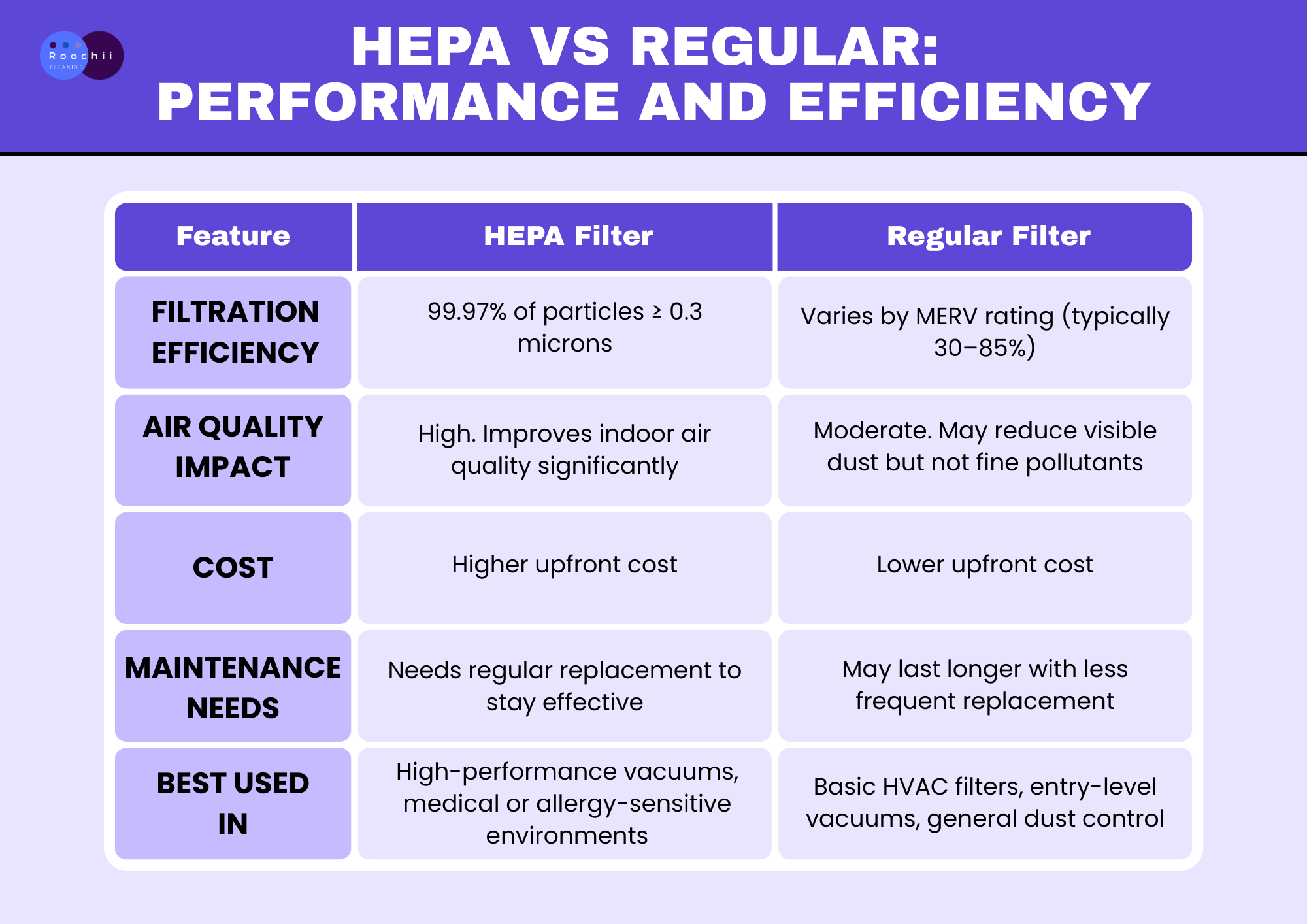
As noted, a true HEPA filter is rated to trap 99.97 % of particles at 0.3 microns.
Regular filters, especially those in typical home HVAC systems, may capture much less of those fine particles. For example, a MERV 13 filter may trap many particles but is not nearly as efficient at trapping particles down to 0.3 microns as a HEPA filter.
B. Efficiency vs Cost Trade‑offs
Regular filters tend to cost less upfront, put less strain on equipment (as they are less dense), and may need less frequent replacement compared to HEPA filters.
On the flip side, HEPA filters cost more and require more care (to maintain airflow and ensure the system still runs efficiently).
Real‑world Impact: What You’ll Feel
With a HEPA filter, you’re more likely to notice fewer airborne allergens in your home: less dust accumulation, fewer allergy triggers, potentially fewer asthma flare‑ups. The research shows HEPA filters help improve indoor air quality.
With a regular filter, you may still capture large particles like visible dust, pet fur and some pollen, but you’re leaving behind more of the “invisible” fine particles. These are things that can linger in the air and settle slowly.
While a HEPA filter can make a big difference, the improvement depends on correct installation, proper maintenance, and that the rest of the system is suitably sealed.Bottom line: If you want the highest level of clean air (especially for allergy sufferers or sensitive occupants), HEPA wins. If you’re on a budget or your air quality needs are lower, a regular filter may suffice, but you’ll accept a trade‑off.
Comparing Other Filter Types: HEPA vs Carbon & More
Beyond just HEPA filter vs normal filter, there are other types you may encounter: activated carbon filters, pre‑filters, “HEPA‑type” filters, etc.
Let’s clarify how these compare.
A. HEPA Filter vs Carbon Filter
A carbon filter is specifically designed to adsorb gases, odors, volatile organic compounds (VOCs) and chemical pollutants. These are things that HEPA filters (which are primarily for particulates) don’t address as efficiently.
A study of mobile air cleaners found that while particulate matter removal is effective with HEPA filters the removal of VOCs requires gas‑phase filters.
Carbon filters and HEPA filters serve somewhat different purposes: HEPA for particulates, carbon for gases/odours. A system may use both.
B. HEPA vs Non‑HEPA vs “Normal” Filters
Compared to “normal” filters (regular standard filters) and non‑HEPA filters, HEPA offers higher efficiency but at higher cost and stricter requirements.
When you see marketing like “HEPA filter vs non HEPA” or “HEPA vs regular filter,” just remember: the terms “regular” or “non HEPA” are broad. They may include filters good enough for moderate use, but not designed for the highest purity needs.
Choosing the Right Filter for Your Needs
You may now know the difference between all the filters, but how do you decide which filter type is right for you?
Match the Filter To Your Cleaning Routine
If your aim is “routine cleaning” (vacuuming, dusting, etc.) then a standard filter may suffice. If your aim is “top-tier air purity” (e.g., allergy‑free home, pet‑heavy household, or people with asthma) then choosing a true HEPA filter is a smart move.
Not sure what filter works best for your home? That’s where Roochii Cleaning comes in. At Roochii Cleaning, our team uses high-grade HEPA-filtered vacuums to ensure every cleaning session leaves your space not only spotless but also healthier to live in.
Consider Air Quality and Occupant Sensitivity
You may consider answering the following questions to great a clearer idea.
- Do you or others in your home have allergies, asthma or respiratory sensitivities? Then going with a HEPA filter (or a device that uses one) makes good sense.
- Is your indoor air prone to high dust, pet dander, pollen, or you live in an urban/polluted area? Again, HEPA likely wins.
- Is this more of a general cleaning routine, fewer sensitivities, easier budget? A high‑quality regular filter might serve reasonably well.
Consider Equipment and System Compatibility
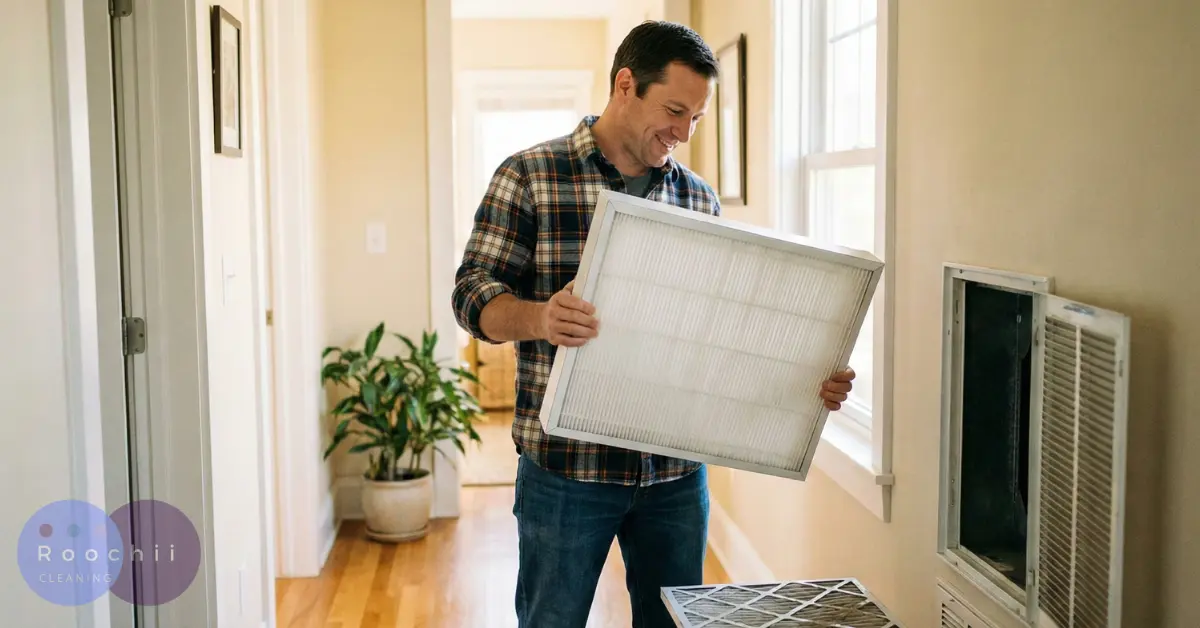
If you’re replacing filters in HVAC systems, check if your system can handle a denser filter (HEPA) without reducing airflow or over‑taxing the fan. Regular filters may be lower resistance.
For standalone air purifiers or vacuums, ensure the unit is sealed and specify “true HEPA filter” if you want the assurance of the rated performance.
Maintenance, Cost and Practical Realities
When choosing filters, it’s important to factor in both upkeep and cost.
HEPA filters typically cost more upfront due to their advanced construction and high filtration standards. They also tend to require more frequent replacements or checks, especially if you’re using them in environments with lots of dust, allergens, or pet hair.
To maintain their effectiveness, HEPA filters need to be kept clean and unclogged. Otherwise, they can restrict airflow and reduce the efficiency of your vacuum or air purifier.
Regular filters, on the other hand, are generally more affordable and often last longer between changes. However, they don’t offer the same level of particle capture, which means you’re trading some air quality for convenience and lower maintenance.
Ultimately, your choice should depend on how clean you want your air to be and how much effort you’re willing to put into keeping your filter in top shape.
Final Thoughts: Choosing Between HEPA and Regular Filters
Deciding between a HEPA filter and a regular filter ultimately comes down to how clean you want your indoor air to be.
While regular filters can be sufficient for general cleaning needs and lower-sensitivity households, true HEPA filters offer a significant advantage when it comes to capturing fine particles like dust, allergens, and pollutants.
That said, it’s not just about buying the right filter but about ensuring the system you’re using is sealed and designed to support that filter.
With the right setup, you’ll enjoy a healthier, fresher, and more breathable home.
FAQ
FAQs on HEPA vs Regular Filter
A HEPA filter is designed to capture very fine particles (down to ~0.3 microns) at a very high efficiency (≥ 99.97 %), while a regular filter is typically less dense, engineered for larger particles.
If you are doing general cleaning, have fewer allergy/respiratory concerns, are working within budget or system limitations, a high‑quality regular filter may be sufficient.
HEPA filters are especially good for trapping fine airborne particles, allergens, pet dander, mold spores, and thus improving indoor air quality.
They are often used in homes with allergy sufferers, in urban environments, in cleaning devices designed for high performance.
No. Some filters are labelled “HEPA‑type” or “HEPA‑style,” but might not meet the standard of 99.97 % capture at 0.3 microns.
Because even if the filter media is HEPA‑rated, the device may not be sealed well (allowing bypass), the filter may be damaged or clogged, or the overall system may not support the airflow and design required for full performance.