Skip to content

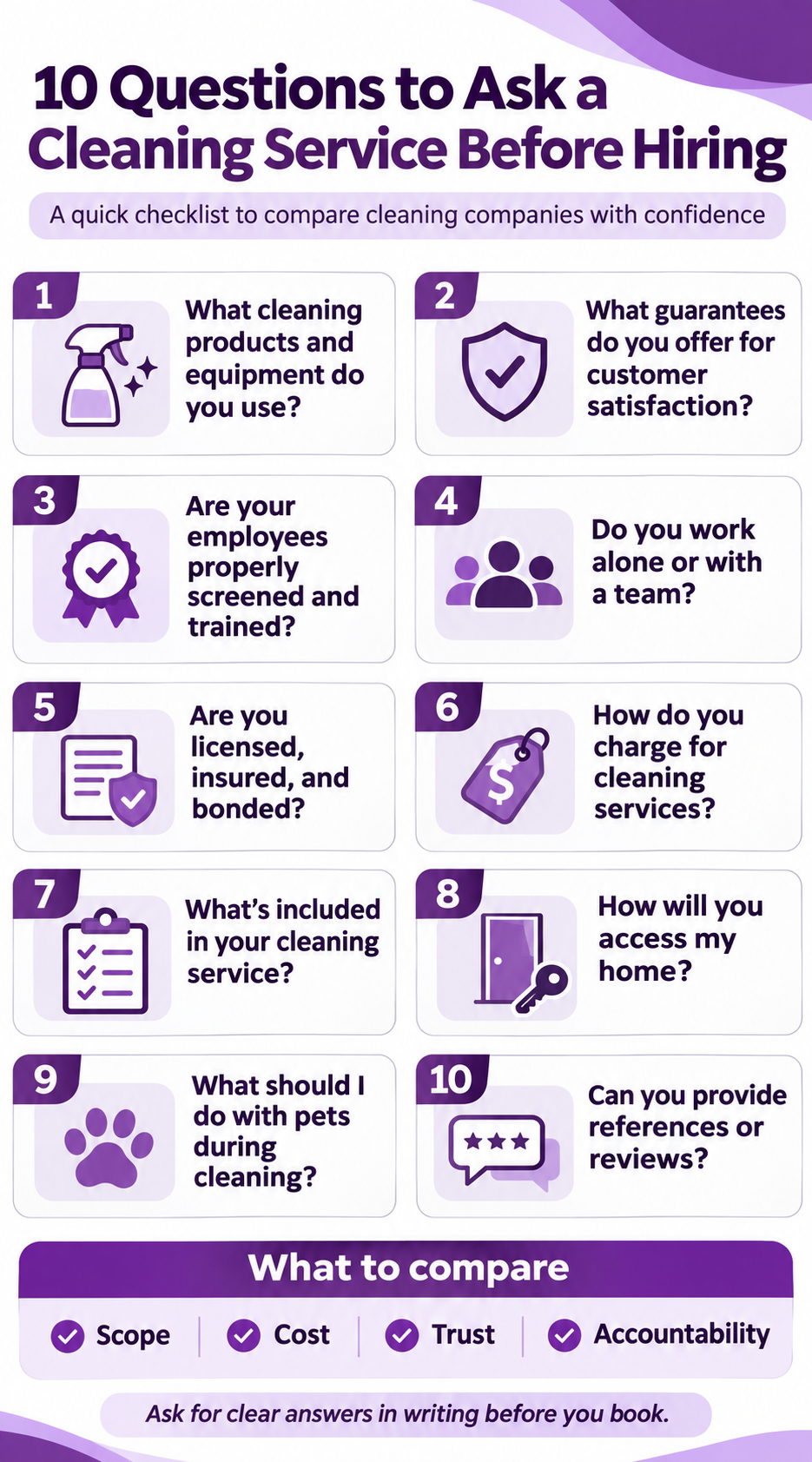
10 Questions to Ask a Cleaning Service Before Hiring

What to Ask Before Hiring a Cleaning Service
Hiring a cleaning service starts with a simple question: Can you trust this company to clean your home the way you expect, for the price you agreed to?
Before booking, ask exactly what’s included, how pricing works, who will enter your home, and what happens if something goes wrong.
These answers matter more than a polished sales pitch or an impressive list of services.
The goal is less housework, not a part-time job deciphering surprise charges.
These ten questions will help first-time customers and homeowners switching providers compare cleaning companies, spot warning signs, and choose a service that fits their home and budget.
In this guide, you’ll learn which questions to ask before hiring a cleaning service, what reliable answers sound like, which details to request in writing, and how to compare providers without relying on price alone.
Jovany Explains: 10 Must-Ask Questions Before Hiring a Cleaning Company
1. What Cleaning Products and Equipment Do You Use?
The products and tools used during cleaning should be appropriate for your home’s surfaces and any preferences you’ve discussed.
If you have children, pets, fragrance sensitivities, or specialty materials, discuss those needs before the appointment.
Do You Bring Your Own Cleaning Supplies?
Ask whether the company provides:
- Cleaning products and microfiber cloths.
- Vacuum cleaners and attachments.
- Mops and other floor-cleaning equipment.
- Specialty products for stone, wood, or delicate finishes.
- Alternative products when a homeowner requests them.
If you prefer a particular product, ask whether the company can use it and whether doing so affects the service or its policies.
Are Eco-Friendly Cleaning Products Always Safer?
Not necessarily.
Terms such as “natural,” “green,” and “eco-friendly” do not automatically explain a product’s ingredients, appropriate uses, or compatibility with your home.
The EPA Safer Choice program evaluates products against defined criteria, but cleaners still need to follow product labels and surface-manufacturer instructions.
Ask the company to identify its products and explain how they are selected.
Cleaning products should not be mixed unless their labels specifically direct you to do so. Different formulations can react with one another or damage certain surfaces, so professional cleaners should follow product instructions and choose methods suited to each material.
What to look for: Products the company can identify, clear safety procedures, and cleaning methods suited to each surface.
2. What Guarantees Do You Offer for Customer Satisfaction?
Even experienced cleaners can occasionally miss a task or make a mistake.
What’s important is whether the company has a straightforward process for responding.
One of our clients, Melanie, had hired another cleaning company before choosing Roochii Cleaning. Unfortunately, she was disappointed with the results because several areas of her home had been missed.
To make matters worse, the company didn’t offer a satisfaction guarantee. Her experience shows why it’s worth asking what happens when a cleaning doesn’t meet expectations before booking a service.
Ask About the Satisfaction Guarantee
Before relying on a guarantee, find out:
- How quickly must I report an issue?
- What information or photos should I provide?
- Will someone return to correct missed tasks?
- Is there an additional charge for a re-clean?
- What happens if the follow-up doesn’t resolve the concern?
A guarantee is most useful when the eligibility requirements and reporting process are clear.
For example, Roochii Cleaning’s Denver cleaning team publicly describes a satisfaction promise that includes hiring a competitor to reclean an unsatisfactory job.
As with any service guarantee, customers should confirm the current terms before booking.
Ask how the company handles accidental property damage, including who to contact, how quickly an incident must be reported, and whether photos or other documentation are required.
A clear claims process helps homeowners understand what to expect if something is damaged during cleaning.
What to look for: A written complaint process, clear reporting deadlines, and an accountable contact person.
3. Are Your Employees Properly Screened and Trained?
When someone enters your home, you should understand how the company selects, prepares, and supervises its cleaners.
Background screening is useful, but it isn’t a substitute for training or clear accountability.
What Does the Screening Process Include?
Ask whether the company verifies employee identities, conducts relevant background checks where permitted, and applies its screening procedures to everyone who may enter your home.
You can also ask whether cleaners are employees, independent contractors, or subcontractors.
A subcontracting arrangement is not automatically a problem. What’s important is whether the same screening, training, supervision, and service standards apply to the people performing the work.
What Training Do Cleaners Receive?
Professional cleaning involves more than knowing which cloth to use.
Ask how the team is trained to:
- Recognize delicate or specialty surfaces.
- Follow cleaning-product instructions.
- Avoid transferring dirt between bathrooms and kitchens.
- Use equipment appropriately.
- Handle fragile belongings.
- Report accidents or damage.
- Follow the company’s cleaning checklist.
For example, acidic cleaners such as vinegar can etch marble and other acid-sensitive stone. Excess moisture can also damage hardwood floors and finishes. These are reasons to ask whether staff receive surface-specific training.
Certifications from organizations like the Institute of Inspection, Cleaning, and Restoration Certification (IICRC) are a strong sign of professionalism. They show the company invests in developing staff expertise and upholding industry best practices.
However, the practical question is what employees are taught and how the company checks their work.
What to look for: A defined training process, consistent procedures, and clear responsibility when something goes wrong.
4. Will the Same Cleaner or Team Visit Each Time?
Staffing arrangements affect consistency, scheduling, communication, and how familiar cleaners become with your home.
Some people prefer an independent cleaner who provides personalized service. Others want a company that can arrange replacement staff when someone is unavailable.
Neither option is automatically the right choice for everyone.
Independent Cleaner vs. Cleaning Company
An independent cleaner may offer direct communication and a consistent person at each appointment. However, backup arrangements may be limited when that person is unavailable.
A cleaning company may have additional cleaners, office support, and established scheduling processes.
Still, you should not assume that every company sends the same team or provides backup coverage.
Questions Worth Asking
- Will the same cleaner or team return for recurring visits?
- How many people will arrive?
- How long is the appointment expected to take?
- What happens if a cleaner is sick or unavailable?
- Will I be notified before someone new is assigned?
- Who should I contact about my cleaning preferences?
If consistency matters to you, explain that before booking.
What to look for: A clear staffing arrangement and realistic expectations about team assignments.
5. Are You Licensed, Insured, and Bonded?
Inviting a cleaning professional into your home involves practical risks, including accidental damage and injuries.
Ask what business registrations, licenses, or permits apply in your location, and what insurance protection the cleaner or company carries.
Requirements can vary depending on the location, business structure, and employment arrangement.
Which Types of Coverage Should You Ask About?
Three common categories are worth understanding.
- General liability insurance: Ask whether the company carries coverage for applicable third-party property damage or injury claims, and what exclusions or limits may apply.
- Workers’ compensation insurance: Ask how workplace injuries are covered and whether the company meets applicable employment and insurance requirements.
- Bonding or employee dishonesty coverage: Ask whether the company carries any relevant protection and what types of losses it covers.
These protections are not interchangeable, and none should be treated as a guarantee that every incident will be covered.
Can They Provide Proof of Insurance?
Request current documentation, such as a certificate of insurance, and ask for clarification if the coverage is unclear.
Also verify the business name you’re hiring and who is responsible for responding to a complaint or claim.
Be cautious if a provider refuses to explain its coverage or relies only on statements such as, “We’ve never had a problem.”
What to look for: Clear business information, relevant coverage documentation, and an explanation of how an incident would be reported.
6. How Do You Charge, and Are There Additional Fees?
A low cleaning quote doesn’t help much if you don’t know what it covers.
Before comparing companies, find out how their prices are calculated and which circumstances could change the final bill.
Flat-Rate vs. Hourly Cleaning
Cleaning companies commonly use flat-rate or hourly pricing.
With a flat rate, the company quotes a price for an agreed scope of work. Ask what happens if the condition of your home differs from the information you provided.
With hourly pricing, ask how many cleaners are included, whether the quoted rate is per cleaner or per team, and how additional time is approved.
Neither pricing method is automatically better. The important thing is understanding the agreement.
Questions to Ask About Cleaning Costs
Before accepting a quote, clarify:
- Is the estimate based on the number of rooms, square footage, condition, or expected time?
- Does the first cleaning cost more than recurring visits?
- Are cleaning supplies and equipment included?
- Do ovens, refrigerators, interior windows, or other extras cost more?
- Are travel, parking, minimum-visit, or other fees applicable?
- How and when will payment be collected?
- Will the company ask for your approval before adding charges?
A written estimate should identify the tasks, pricing method, and circumstances that could change the total.
3 Things to Get in Writing Before Booking
A quick checklist to help avoid unexpected charges, missed tasks, and unclear policies.
Cleaning Scope & Checklist
Know exactly what the cleaning team will and won't do.
- Included rooms and cleaning tasks
- Excluded services
- Optional add-ons and special requests
Written Price Estimate
Understand the price before agreeing to the appointment.
- Flat-rate or hourly pricing
- Supplies, fees, and additional charges
- Conditions that could change the total
Booking & Service Policies
Find out what happens when plans change or problems arise.
- Cancellation and rescheduling rules
- Payment terms and deadlines
- Satisfaction and damage-reporting process
Before you confirm: If an important task, fee, or policy is unclear, ask the company to clarify it in writing. A few extra questions now can prevent misunderstandings later.
What to look for: A clear estimate that lets you compare the same work across different companies.
7. What Are Your Scheduling, Cancellation, and Payment Policies?
Cleaning needs change.
A family trip, illness, emergency, or unexpected appointment can affect a scheduled visit.
Before signing up, make sure you understand how changes are handled.
Ask About Cancellations and Rescheduling
Find out:
- How much notice is needed to cancel or reschedule?
- Are there late-cancellation or lockout fees?
- What happens if the cleaner arrives but cannot enter?
- Can recurring customers skip a visit?
- How are holidays and cleaner absences handled?
- Is there a minimum commitment or ongoing contract?
- Can recurring prices change, and how is notice provided?
Also confirm whether a missed visit changes the next appointment’s scope or price.
Understand the Payment Process
Ask whether payment is due before or after the visit, which methods are accepted, and when an invoice or receipt is provided.
If a company requires a deposit, make sure the amount and refund conditions are clearly explained.
What to look for: Written scheduling and payment terms that you understand before committing.
8. What’s Included in Your Cleaning Service?
Not every cleaning company defines standard cleaning, deep cleaning, or recurring cleaning the same way.
One company may include baseboards in its regular service. Another may treat them as a deep-cleaning task. Even something as simple as cleaning inside a microwave can vary between packages.
The best way to avoid misunderstandings is to request a written cleaning checklist before booking.
Ask for a Room-by-Room Cleaning Checklist
A detailed checklist should explain which tasks are included in areas such as:
- Kitchen: Counters, sinks, appliance exteriors, cabinet fronts, and floors.
- Bathrooms: Toilets, showers, sinks, mirrors, and accessible surfaces.
- Bedrooms: Dusting, vacuuming, and floor cleaning.
- Living areas: Furniture dusting, floors, and commonly used surfaces.
Ask which tasks are included in your specific package rather than assuming every item above is standard.
What’s the Difference Between Standard and Deep Cleaning?
Standard cleaning generally focuses on maintaining regularly used areas.
Deep cleaning may involve more detailed work on buildup, edges, trim, or areas that receive less frequent attention.
However, labels alone don’t determine what you’ll receive.
Standard Cleaning vs. Deep Cleaning
Compare typical cleaning tasks before choosing your service.
| Cleaning Area | Standard Cleaning | Deep Cleaning |
|---|---|---|
| Dusting | Dusting accessible furniture, shelves, and surfaces. | More detailed dusting, including reachable corners, edges, and trim. |
| Kitchen | Cleaning countertops, sinks, and appliance exteriors. | Extra attention to grease and buildup. Inside appliances only when included. |
| Bathrooms | Routine cleaning of toilets, sinks, mirrors, and shower surfaces. | More detailed removal of soap scum and buildup, including grout when specified. |
| Floors | Vacuuming and mopping accessible floor areas. | Extra attention to floor edges, corners, and areas normally overlooked. |
| Baseboards & Trim | Spot dusting or wiping when included in the cleaning checklist. | More detailed cleaning of baseboards, door frames, and trim when included. |
| Best Suited For | Regular household upkeep and recurring cleaning visits. | First-time visits, periodic detailed cleaning, and areas with accumulated buildup. |
Can You Customize Your Cleaning?
Tell the company about any special priorities before requesting your quote.
These might include:
- Extra attention to the kitchen or bathrooms.
- Pet hair on furniture or floors.
- Delicate countertops or flooring.
- Rooms you don’t want cleaned.
- Inside-appliance cleaning or other optional tasks.
Also ask whether laundry, dishes, organizing, exterior windows, and moving heavy furniture are excluded.
A reliable company should explain what it can accommodate and whether additional time or charges are required.
What to look for: A written scope of work with clear inclusions, exclusions, and optional services.
9. How Will You Access My Home, and What Should I Do With My Pets?
Many homeowners arrange cleaning while they’re at work or away from home.
That can be convenient, but it makes clear home-access procedures especially important.
How Does the Company Handle Keys and Entry Codes?
Discuss the options available, such as:
- Meeting the cleaner at the first appointment.
- Providing a temporary smart-lock code.
- Using a secure lockbox.
- Arranging another approved key-access method.
Ask who can access those details, how access information is protected, and whether the company confirms that doors are locked and alarms are handled correctly when the team leaves.
If a company uses cameras or other monitoring technology, ask about its privacy and recording policies before consenting.
What About Dogs, Cats, and Other Pets?
Tell the cleaning company about your pets, even if they are usually friendly.
Vacuum noise, unfamiliar visitors, and open doors can create problems for animals that are nervous or prone to escaping.
Ask whether your pets should remain in a separate room, whether the team can work around them, and how doors will be managed.
Also identify any pet supplies, food bowls, bedding, or areas that need special handling.
A brief introduction may help some animals, but it does not replace secure arrangements when a pet is anxious or reactive.
What to look for: A clear access plan, respect for your privacy, and realistic arrangements for pets.
10. Can You Provide Recent Reviews or Customer References?
A cleaning company’s reputation matters, but a high star rating alone does not tell the whole story.
Look for patterns in recent customer feedback rather than focusing on one enthusiastic review or a single complaint.
What Should You Look for in Reviews?
Check feedback on sources such as Google, Yelp, Facebook, and relevant local review platforms.
Pay attention to comments about:
- Arriving when scheduled.
- Completing the agreed scope of work.
- Communicating before and after appointments.
- Handling delicate items respectfully.
- Responding to complaints.
- Maintaining consistency across repeat visits.
The Federal Trade Commission recommends checking multiple review sources and being alert to suspicious review patterns.
What to look for: Recent, credible feedback and a company that takes customer concerns seriously.
How to Compare Cleaning Services Before Booking
Once you’ve asked the ten questions, compare companies using the same requirements.
Start with a consistent description of your home, requested tasks, cleaning frequency, and special priorities. Otherwise, you may end up comparing quotes for different jobs.
Prioritize these four things:
- Scope: Does the company offer the tasks you actually need?
- Cost: Is the price clear, including any relevant add-ons or fees?
- Trust: Can the company explain its staffing, training, coverage, and home-access procedures?
- Accountability: Are the cancellation, damage, and satisfaction policies clear?
A lower quote with fewer included tasks may not be better value.
Likewise, a higher price should come with an explanation of what you’re getting.
Green Flags vs. Red Flags When Hiring a Cleaning Service
Know what to look for before trusting a cleaning company with your home.
| What to Check | Green Flags | Red Flags |
|---|---|---|
| Communication | ✓
Clear, detailed answers to
your questions.
| ✕
Vague, inconsistent,
or evasive responses.
|
| Pricing | ✓
Written estimates explaining
pricing and additional fees.
| ✕
Verbal-only estimates and
unexplained charges.
|
| Insurance | ✓
Provides relevant proof of
insurance upon request.
| ✕
Avoids discussing coverage
or refuses to clarify it.
|
| Staff Screening | ✓
Explains how cleaners
are screened and trained.
| ✕
Cannot explain hiring,
screening, or training
procedures.
|
| Service Checklist | ✓
Clearly identifies included
tasks and optional services.
| ✕
Unclear about what's
included in the service.
|
| Customer Reviews | ✓
Recent, credible reviews
with consistent positive
feedback.
| ✕
Repeated unresolved
complaints or suspicious
review patterns.
|
| Reliability | ✓
Communicates professionally
and explains scheduling
procedures.
| ✕
Repeated communication
delays or unreliable
scheduling.
|
| Satisfaction Guarantee | ✓
Clear process for reporting
and resolving cleaning
concerns.
| ✕
No clear explanation of
how complaints or missed
tasks are handled.
|
Remember: One red flag doesn't always mean you should walk away. Ask for clarification and pay attention to repeated patterns. A reliable cleaning company should be able to explain its services and policies clearly.
Compare Cleaning Services Side by Side
Keep quotes, services, and policies organized in one place. Use this printable worksheet to compare up to three cleaning companies before deciding who to hire.
- Compare 3 companies
- Record 10 key answers
- Track pricing and policies
PDF format • 2 printable pages
Common Mistakes to Avoid When Hiring a Cleaning Service
Even a little preparation can prevent disagreements later.
Some common mistakes include:
- Choosing the lowest price without comparing the included tasks.
- Assuming that standard cleaning means the same thing everywhere.
- Not confirming insurance or screening procedures.
- Waiting until cleaning day to mention fragile surfaces.
- Forgetting to discuss pets and home access.
- Overlooking late-cancellation fees or recurring-service terms.
- Relying entirely on star ratings.
- Booking without understanding the satisfaction or damage policy.
If you’re uncertain about a company, consider starting with a single visit before committing to recurring cleaning.
Evaluate the quality of the work, communication, punctuality, and whether the agreed checklist was followed.
Final Thoughts: Choose a Cleaning Service With Clear Answers
Hiring a cleaning service should make life easier, not introduce a new set of uncertainties.
The best starting point is a written checklist, an understandable quote, appropriate protections, and a company that explains what happens when plans change or problems arise.
Ask the ten questions, compare the details, and choose a provider whose service matches your expectations.
If you’re considering professional help, explore Roochii Cleaning’s house cleaning services and request a quote based on the tasks your home actually needs.
FAQ
Frequently Asked Questions About Hiring a Cleaner
Request a written cleaning checklist, an estimate, details of applicable insurance coverage, and the company's cancellation and satisfaction policies. Also clarify who will clean your home, what supplies they bring, and any tasks that cost extra.
That depends on your home's size, condition, priorities, and whether one cleaner or a team is working.
A three-hour appointment might cover several routine tasks, but it should not be treated as a guarantee of a whole-home deep cleaning. Ask the provider to estimate what can realistically be completed within the booked time.
Describe the service you need, then ask about experience, training, insurance, supplies, price, scheduling, and what happens when an appointment doesn't go as expected. Use the same questions for each candidate so the answers are easier to compare.
Point out high-priority rooms, fragile belongings, off-limits areas, and surfaces that need special care. Confirm which tasks are included, how long the work may take, and whether the estimate changes based on the home's condition.
Comparing around three cleaning companies can help you understand differences in price, scope, availability, and policies. It isn't necessary to contact a fixed number, but use the same requirements when requesting quotes so the comparison is meaningful.
Both can provide good service. An independent cleaner may offer a more direct working relationship, while a company may offer additional staffing and administrative support. Compare the specific provider's experience, coverage, reliability, and policies rather than assuming one business model is automatically better.
Weekly or biweekly visits may suit busy households that want regular maintenance. Monthly cleaning or occasional deep cleaning may be enough for other homes. Consider how quickly your home becomes dirty, the size of your household, pets, budget, and which chores you handle between appointments.