Who Sets Cleaning Standards: Industry Explained
Who Sets the Standards of Care in Cleaning?
Simply put, cleaning standards are set by independent organizations that specialize in developing safe, science-based practices for the cleaning industry. These are mainly the Institute of Inspection, Cleaning and Restoration Certification (IICRC) and the Worldwide Cleaning Industry Association (ISSA).
For most people, cleaning might seem straightforward: spray, wipe, done. But for professionals, there’s a lot more at stake. That’s why industry standards exist. It’s to make sure every cleaner, everywhere, follows proven methods that protect both people and property.
For cleaning companies, following these standards is what separates routine cleaners from certified professionals.
In this article, we’ll look at:
Who Sets The Industry Standard for Cleaning?
Cleaning standards exist to make sure both the process and the outcome of every cleaning task are consistent, safe, and measurable. Without them, every cleaner could define “thorough” differently.
Cleaning standards aren’t created by governments or corporations. Instead, they’re developed by independent organizations that specialize in research, training, and certification. Two of the most important names you’ll hear again and again are IICRC and ISSA.
Together, they define how cleaning should be performed, from the tools you use to the way you manage your business.
For cleaning businesses, following recognized cleaning standards doesn’t just show skill. It builds trust. Clients know that the service they’re paying for is backed by science, not just preference.
IICRC: The Technical Authority in Cleaning and Restoration
The Institute of Inspection, Cleaning and Restoration Certification (IICRC) is one of the most trusted names in the cleaning industry.
Since 1972, the IICRC has set the standards that define what true professional cleaning looks like: safe, effective, and backed by science. The IICRC is one of the most respected organizations in the cleaning and restoration industry.
The IICRC’s standards are American National Standards Institute-approved (ANSI), meaning they undergo a rigorous public review and expert validation process before being adopted.
And these standards go far beyond surface-level cleanliness. They define how to handle real-world challenges like:
- Moisture control and water damage restoration, including how to measure and maintain acceptable humidity and moisture thresholds after leaks or floods.
- Proper vacuum filtration systems, such as HEPA-rated equipment, which trap 99.97% of airborne particles and prevent allergens, dust, and microbes from being recirculated into the air.
- Microbial remediation practices, which focus on safely identifying, treating, and preventing mold and bacteria growth in homes and buildings.
At Roochii Cleaning, we are IICRC-certified, which means our entire team is trained and tested under the industry’s most trusted cleaning and restoration standards.
For us, professionalism isn’t just about making spaces look clean. Every service we deliver in Colorado follows IICRC-approved methods, so we can guarantee that your home or business meets your expectations and the industry’s highest standards.
ISSA: The Global Voice of the Cleaning Industry
While the IICRC focuses on the technicalities of cleaning, the ISSA (Worldwide Cleaning Industry Association) focuses on the why and what’s next. It’s the organization that helps cleaning companies think beyond technique and look at how they manage their entire operation.
One of ISSA’s biggest contributions is the Cleaning Industry Management Standard (CIMS), a framework that acts like a blueprint for how a professional cleaning business should operate.
The CIMS framework focuses on key areas that make a cleaning company stand out:
- Quality management systems – setting clear processes to ensure reliable service.
- Green cleaning and sustainability (CIMS-GB) – encouraging safer, eco-friendly cleaning methods that protect both people and the planet.
- Ongoing staff training and development – ensuring teams stay skilled and knowledgeable as standards evolve.
- Performance measurement and client feedback – keeping communication open and services continuously improving.
At Roochii Cleaning, we take inspiration from the ISSA’s standards to strengthen how we manage quality, train our team, and ensure client satisfaction.
One recent example was a senior couple in Denver whose mobility issues had made deep cleaning nearly impossible. We used a standardized cleaning checklist, paired new staff with experienced trainers, and conducted a post-service walk-through to transform their cluttered, high-risk home into a manageable space.
The couple later shared that our support helped them avoid an impending eviction notice from their housing provider.
Experiences like these are why quality management and continuous improvement matter so much in our work.
Why Cleaning Standards Matter for Cleaning Businesses and Clients
Operating without recognized cleaning standards is like flying without a flight plan: risky, inconsistent, and hard to prove safe.
Cleaning standards don’t just exist for regulation’s sake. They’re there to protect both the service provider and the client.
Here’s how they make a real difference.
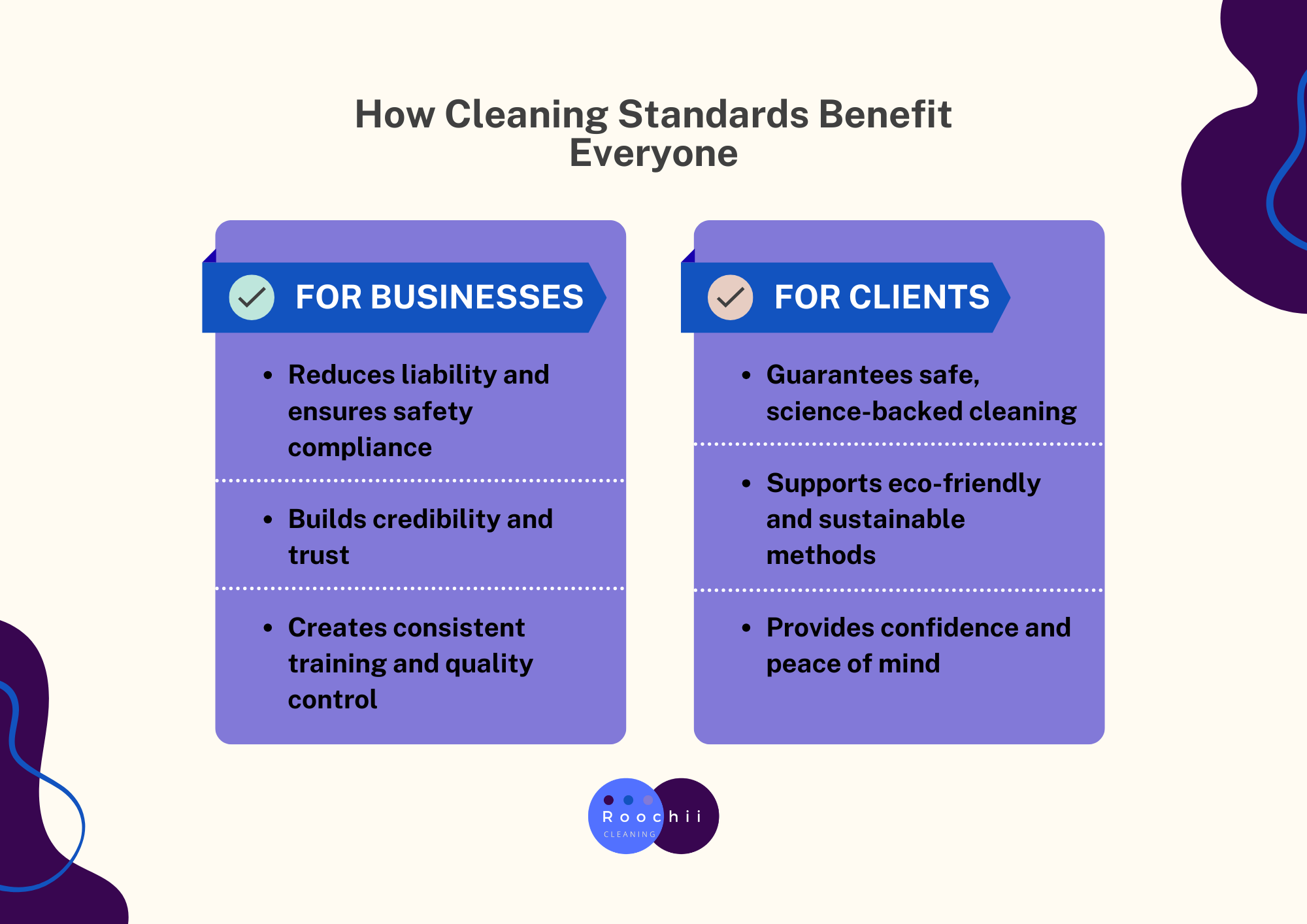
For Cleaning Businesses: The Backbone of Professional Credibility
1. Legal and Safety Protection
Cleaning often involves handling chemicals, electrical tools, and sensitive materials. Following recognized standards helps companies comply with health and safety regulations.
- Proper labeling and storage of cleaning agents reduce the risk of accidents or chemical burns.
- Documented cleaning procedures protect businesses in the event of disputes or liability claims.
- Standards-based documentation proves that cleaning was done to a verified professional level.
2. Credibility and Trustworthiness
Certifications like IICRC or CIMS instantly signal professionalism. They show that a business doesn’t rely on guesswork or “quick clean” shortcuts but instead follows science-backed, globally accepted methods.
3. Training, Consistency, and Quality Control
Standards serve as the framework for training programs, ensuring every team member cleans the same way, every time.
- Staff can be trained to identify surface types, chemical compatibilities, and cleaning frequencies.
- Supervisors can measure performance using objective benchmarks.
- Over time, this consistency builds a brand reputation for reliability and excellence.
For Clients: Confidence, Safety, and Health
1. Scientifically Safe Cleaning
When a cleaning company follows recognized standards, clients can trust that every method and product used is based on science, not online trends.
The IICRC sets clear rules for things like moisture control and proper drying to prevent mold and bacteria growth. Meanwhile, ISSA’s CIMS framework ensures that equipment such as HEPA vacuums and microfiber tools meet high sanitation standards.
2. Environmentally Responsible Practices
Modern standards emphasize green cleaning, minimizing harm to people, pets, and the planet.
- Products are chosen based on biodegradability, low VOCs, and safe disposal.
- Equipment efficiency reduces energy and water waste.
- For families and offices concerned about air quality or allergies, this approach provides lasting benefits.
3. Peace of Mind and Professional Assurance
Hiring a certified cleaning company gives clients confidence that every task is done correctly. Each step follows proven, documented procedures. There is no guesswork, no shortcuts.
Clients can feel secure knowing what was cleaned, what products were used, and that their space was treated carefully. Most importantly, they know trained professionals are behind the work.
Conclusion: The Importance of Cleaning Standards in Professional Cleaning
At the end of the day, a cleaning company team might be the one scrubbing, polishing, and sanitizing, but it’s organizations like the IICRC and ISSA that make sure every task is done right, safely, and sustainably.
When a cleaning company aligns with these standards, it’s not just following rules. Instead, it’s embracing accountability, professionalism, and care.
Cleaning standards are more than checklists. They are the foundation of a cleaner, safer, and more trustworthy industry.
FAQ
FAQs on Cleaning Standards
Cleaning standards are detailed guidelines that outline how cleaning tasks should be performed to ensure health, safety, and consistency.
Organizations like the IICRC and ISSA develop and maintain these standards, often in collaboration with ANSI and other industry bodies.
They help businesses prove professionalism, prevent liability, improve quality control, and build lasting client trust.
Clients benefit from safer products, verified cleaning methods, and consistent quality that meets professional benchmarks every time.