Skip to content

Move-Out Cleaning vs. Deep Cleaning: What’s the Difference and Which One Do You Need?

Moving comes with enough decisions already. The last thing you want is to book the wrong cleaning service and discover too late that your oven, cabinets, or refrigerator weren’t included.
While deep cleaning and move-out cleaning are both comprehensive services, they are designed for different situations. Choosing the right one can save you time, money, and, if you’re renting, help improve your chances of receiving your full security deposit.
The short answer: If you’re leaving a home, move-out cleaning is usually the better choice because it includes everything in a deep cleaning plus the inside of appliances, cabinets, drawers, and closets. If you’re staying in your home and simply want a complete reset to keep your home well-maintained, a deep cleaning is typically the better option.
In this guide, you’ll learn the differences between move-out cleaning and deep cleaning, what each service typically includes, how much time they require, when each one makes the most sense, and how to choose the right service for your home.
Table of Contents
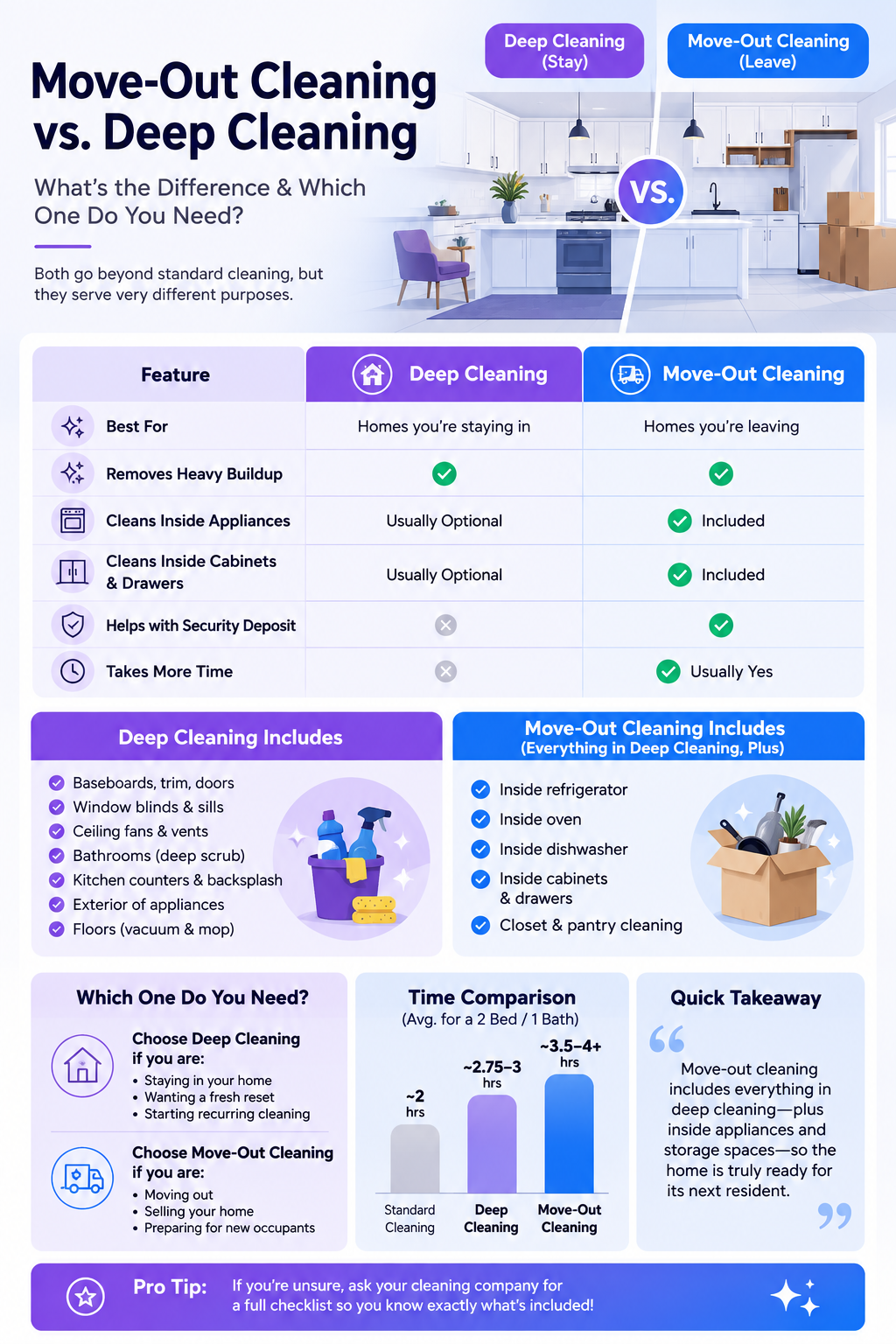
Quick Comparison: Move-Out Cleaning vs. Deep Cleaning
| Feature | Deep Cleaning | Move-Out Cleaning |
|---|---|---|
| Best for | Homes that are still occupied | Homes being vacated |
| Removes heavy buildup | ✔ | ✔ |
| Cleans inside appliances | Usually optional | Included |
| Cleans inside cabinets and drawers | Usually optional | Included |
| Ideal before selling a home | Sometimes | Yes |
| Helps prepare for new occupants | No | Yes |
| Helps with security deposit requirements | No | Yes |
| Takes longer | No | Usually yes |
Which Cleaning Service Should You Choose?
The easiest way to decide is to ask yourself one question:
Are you moving out of the property?
If the answer is yes, move-out cleaning is almost always the better option. It prepares the property for its next occupant by cleaning areas that are often overlooked during everyday housekeeping, such as the inside of cabinets, drawers, closets, refrigerators, ovens, and other appliances.
If the answer is no, but your home hasn’t been professionally cleaned in several months or you want a thorough reset before beginning recurring cleaning services, deep cleaning is usually the right choice.
Many homeowners assume these services are interchangeable. They aren’t. While they share many tasks, move-out cleaning is designed to leave an empty home ready for inspection, sale, or its next resident.
What is Deep Cleaning?
Deep cleaning is a comprehensive cleaning service designed to remove dirt, bacteria, and buildup that accumulates over time. Unlike standard cleaning, which only focuses on basic surface-level tasks, deep cleaning targets areas such as baseboards, window blinds, vents, fans, doors, and door trim to eliminate deep-embedded dirt and grease. This service is beneficial for those who have not had professional cleaning in several months or who want a fresh start in their place.
Deep cleaning goes beyond regular dusting and mopping, for it also involves scrubbing, sanitizing, and reaching deep into areas that are often overlooked in routine cleaning. Professional deep cleaning services ensure that a home is not just neat, but truly clean, eliminating germs, allergens, and deep-seated dirt that may not be visible to the naked eye.
What Does Deep Cleaning Include?
Although every company has its own checklist, a professional deep cleaning commonly includes:
- Washing baseboards, doors, door frames, and trim
- Cleaning window blinds and windowsills
- Dusting ceiling fans, vents, and light fixtures
- Deep scrubbing bathrooms, including showers, tubs, sinks, and toilets
- Degreasing kitchen countertops, backsplashes, stovetops, and sinks
- Vacuuming and mopping all floors
- Removing fingerprints and buildup from high-touch surfaces
- Wiping the exterior of appliances
Many homeowners also choose optional add-ons such as:
- Interior oven cleaning
- Interior refrigerator cleaning
- Interior dishwasher cleaning
- Interior cabinet cleaning
- Wall washing
These additional services are usually priced separately because each appliance or specialty task can add approximately 30 to 60 minutes of labor depending on its condition.
Why Deep Cleaning Takes Longer Than Standard Cleaning
The biggest difference isn’t simply that cleaners perform more tasks. It’s that every task requires significantly more attention.
Instead of quickly wiping a baseboard, cleaners often need multiple passes to remove months of accumulated dust and grime.
Kitchen grease is a mixture of cooking oils, airborne particles, and food residue that bonds to surfaces over time. Professional degreasers need several minutes of dwell time so the cleaning agents can break down these oily residues before agitation removes them. Without enough dwell time, cleaners often have to scrub harder, increasing labor without improving results.
Our cleaning team often finds that homeowners underestimate how much time detailed work actually requires. Cleaning ten vents, twelve sets of blinds, dozens of feet of baseboards, and heavily used bathrooms adds up quickly, even in homes that appear relatively clean.
How Often Should You Get a Deep Cleaning?
The ideal frequency depends on how often your home is professionally cleaned.
As a general guideline:
- Weekly or biweekly cleaning: every 3 to 4 months
- Monthly cleaning: approximately every 3 months
- Homes without recurring professional cleaning: schedule whenever buildup becomes noticeable or before beginning recurring service
Many homeowners also schedule deep cleaning before holidays, hosting guests, or after renovation work.
What is Move-Out Cleaning?
Move-out cleaning is a specialized service designed to restore a property to its original condition before a tenant or homeowner vacates. Unlike deep cleaning, which focuses on maintaining a home for current occupants, move-out cleaning is intended to prepare a home for its next occupiers.
This type of cleaning is particularly important for renters who want to secure their full security deposit and for homeowners who need to ensure that their property is clean and presentable for new buyers or tenants. Many landlords and real estate agents require move-out cleaning before a property is listed for sale or rental.
What Does Move-Out Cleaning Include?
Move-out cleaning includes nearly everything found in a deep cleaning, plus detailed cleaning of spaces that are usually optional during occupied-home services.
A typical move-out cleaning includes:
- Deep cleaning kitchens and bathrooms
- Washing floors, baseboards, trim, and doors
- Cleaning inside refrigerators
- Cleaning inside ovens
- Cleaning inside microwaves and dishwashers
- Wiping inside cabinets and drawers
- Cleaning closets and shelving
- Removing leftover food residue and debris
- Cleaning accessible interior surfaces throughout the home
The goal is to leave the property clean, empty, and ready for its next resident.
Why Move-Out Cleaning Usually Takes Longer
Move-out cleaning requires more time because cleaners aren’t working around furniture. They’re cleaning every accessible surface.
Cabinets need to be emptied and wiped inside. Refrigerators require shelves and drawers to be removed and cleaned individually. Ovens often contain baked-on grease that requires degreaser dwell time before scrubbing.
These detailed tasks can easily add one or more hours compared to a standard deep cleaning, depending on the size and condition of the home.
Who Typically Benefits From Move-Out Cleaning?
Move-out cleaning is commonly recommended for:
- Renters hoping to maximize their security deposit
- Homeowners preparing to sell their property
- Landlords preparing units for new tenants
- Property managers between occupants
- Real estate professionals preparing homes for showings
Beyond appearance, a professionally cleaned home helps create a better first impression while reducing the amount of work required before the next occupant moves in.
Key Similarities Between Move-Out Cleaning vs Deep Cleaning
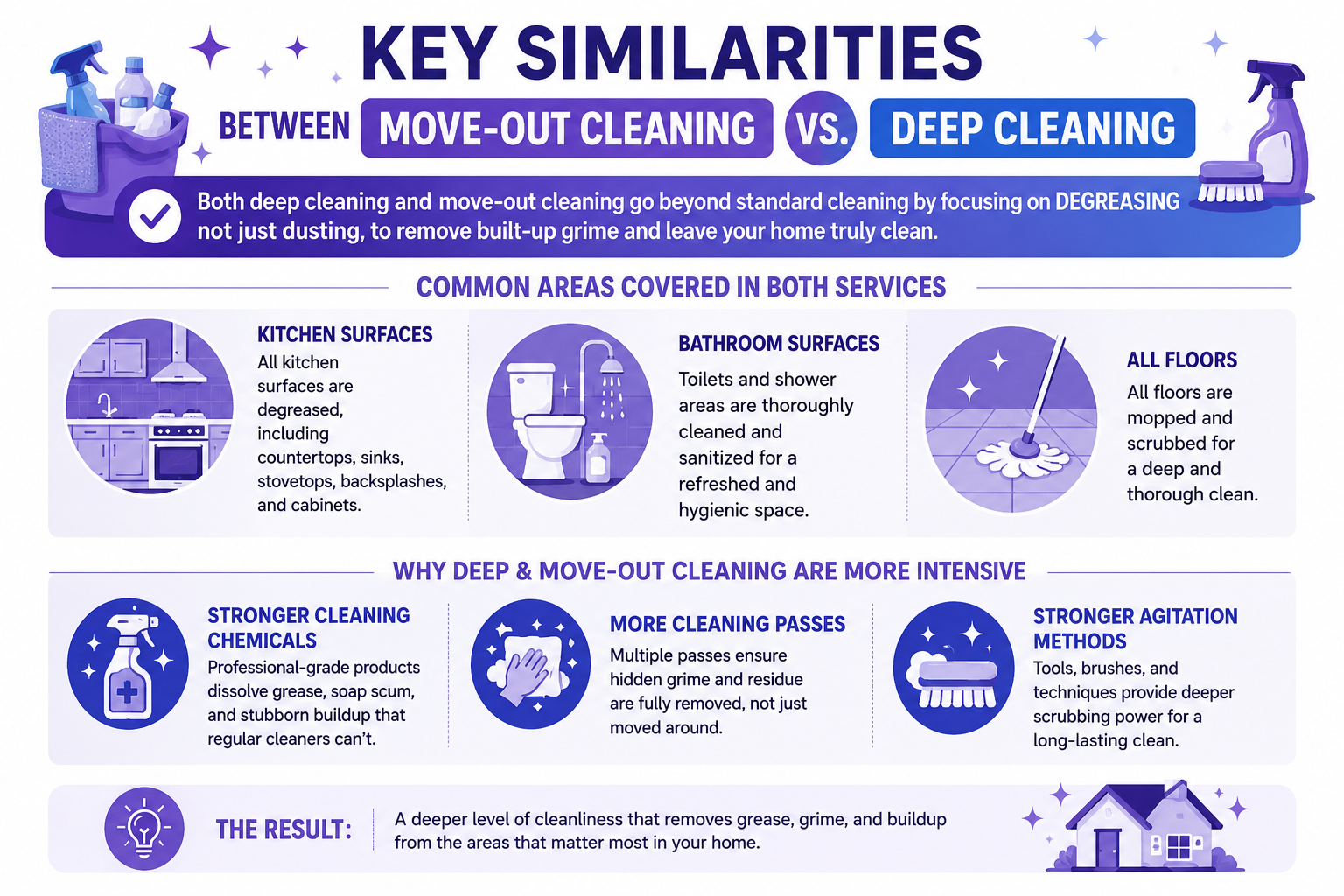
Both deep cleaning and move-out cleaning focus on degreasing rather than just dusting, making them more intensive than standard cleaning. These services target baseboards, vents, fans, window blinds, window sills, and furniture, ensuring the removal of built-up grime and grease.
Other common areas that require degreasing in both deep cleaning and move-out cleaning include:
-
- All kitchen and bathroom surfaces – including countertops, sinks, stovetops, backsplashes, and cabinets.
-
- Toilets and shower areas – ensuring a sanitized and refreshed space.
-
- All floors – mopped and scrubbed for a thorough clean.
- All floors – mopped and scrubbed for a thorough clean.
While kitchens, bathrooms, and floors are also covered in standard cleaning, what sets deep cleaning and move-out cleaning apart is the added level of intensity. Typically, the floors, shower floors, and toilets in deep and move-out cleans require:
-
- Stronger cleaning chemicals to break down tough grime.
-
- More cleaning passes to remove buildup fully.
-
- Stronger agitation methods for a deep and lasting clean.
Key Differences Between Move-Out Cleaning vs Deep Cleaning
Scope of Cleaning
The biggest difference between deep cleaning and move-out cleaning is what areas are included in the service.
-
- Deep cleaning covers all standard cleaning tasks but focuses on more detailed scrubbing and sanitizing. Interior appliance cleaning is not included unless the client requests it.
-
- Move-out cleaning includes interior cleaning of refrigerators, ovens, cabinets, and drawers. We also remove or dispose of any remaining contents inside these appliances, including expired food, spills, and residue.
- Move-out cleaning includes interior cleaning of refrigerators, ovens, cabinets, and drawers. We also remove or dispose of any remaining contents inside these appliances, including expired food, spills, and residue.
Time and Effort Required
The time required for deep cleaning and move-out cleaning varies depending on the level of detail involved and the overall condition of the home.
Generally, deep cleaning services for a two-bedroom, one-bathroom home takes approximately 3 hours, as it includes tasks like degreasing baseboards, window blinds, window sills, vents, and backsplashes, among others.
However, what extends the time of a deep cleaning is the fact that:
The Home is Dirtier, Requiring More Passes and Dwell Time
-
- Floors need multiple passes – A dirty hardwood floor may require at least three passes, with each pass taking 30 minutes, significantly adding to the cleaning time.
-
- Baseboards throughout the house accumulate deep-embedded dirt – If baseboards haven’t been deep cleaned in a while, they require thorough agitation to remove built-up dirt and grime. This process involves scrubbing by hand or using a pole scrubber, followed by drying the surface with a microfiber towel. Since each wall-length section can take approximately 15 minutes, the total cleaning time can quickly add up depending on the number of walls in the home.
-
- Vents accumulate deep debris in each small crevice – Over time, dust, grease, and other airborne particles build up in vents, requiring detailed cleaning to remove embedded grime. Cleaning each vent thoroughly can sometimes take up to 20 minutes, depending on the level of buildup.
- Vents accumulate deep debris in each small crevice – Over time, dust, grease, and other airborne particles build up in vents, requiring detailed cleaning to remove embedded grime. Cleaning each vent thoroughly can sometimes take up to 20 minutes, depending on the level of buildup.
Window Blinds Are Another Major Factor in Time Extension
-
- Small 1-inch vinyl blinds are particularly time-consuming, as they require delicate agitation to prevent breaking.
-
- A typical home may have 12 windows, with each window taking around 20 minutes of labor to ensure a thorough clean.
- A typical home may have 12 windows, with each window taking around 20 minutes of labor to ensure a thorough clean.
Move-out cleaning, on the other hand, takes longer due to its extensive scope. For the same two-bedroom, one-bathroom home, move-out cleaning can take approximately 4 hours or more.
The extra time is necessary because:
-
- Floors take twice as long to clean – Since there is no furniture to break up dirt collection, dust and debris accumulate across the entire floor, requiring more sweeping and mopping.
-
- Inside cabinets and pantries must be deep cleaned – Cleaning inside cabinets adds substantial time because reaching deep into corners requires ladders in many cases.
-
- Ovens require at least 30 minutes of dwell time – Move-out ovens are often full of carbonized grease, meaning a strong degreaser needs to sit before it can be scrubbed away. Thorough agitation is required to fully remove baked-on residue.
-
- Refrigerators must be fully disassembled – Cleaning out a fridge is not just wiping down shelves; every compartment, shelf, and drawer must be removed and scrubbed as many areas have hard-to-reach crevices that require detailed attention and significant agitation to clean properly.
- Refrigerators must be fully disassembled – Cleaning out a fridge is not just wiping down shelves; every compartment, shelf, and drawer must be removed and scrubbed as many areas have hard-to-reach crevices that require detailed attention and significant agitation to clean properly.
Cost Considerations
Although deep cleaning and move-out cleaning are charged at the same hourly rate of $95 per hour, the total cost depends on the time required. Deep cleaning is generally less expensive because it requires fewer hours.
Move-out cleaning costs more overall due to the additional labor involved in cleaning inside appliances, cabinets, and closets. Each major appliance, like refrigerators and ovens, can take up to 30 – 60 minutes to clean properly, which increases the total service duration. While the hourly rate remains the same, the extra time and effort required for move-out cleaning naturally result in a higher overall cost.
For a clearer comparison, at Roochii Cleaning in Denver, a two-bedroom, one-bathroom home typically requires:
-
- 2 hours for standard cleaning.
-
- 2.75 hours for deep cleaning.
-
- 3.5 hours for move-out cleaning.
| Move Out Cleaning | Deep Cleaning | |
| The Premier Customer Experience | ✔ | ✔ |
| The Kitchen Wash: Cabinets, Counters | ✔ | ✔ |
| The Bathroom Wash: Cabinets, Counters | ✔ | ✔ |
| Floors Vacuumed and/or Mopped | ✔ | ✔ |
| Touch Points: Switches, Handles, Doorknob, Cabinet | ✔ | ✔ |
| The Kitchen Exfoliation: Removal of Medium/Heavy | ✔ | ✔ |
| The Bathroom Exfoliation: Removal of Medium/Heavy | ✔ | ✔ |
| Inside Oven, Fridge, Dishwasher, and Cabinets | ✔ | ✘ |
| Blinds, Drapes, Valances, Upholstery | Disinfected | Disinfected |
| Ceiling Fans, Blades, Lights, and Lamp Shades | Washed | Washed |
| Furniture and Belongings | Washed | Washed |
| Door and Window Frames, Ledges, and Locks | Washed | Washed |
| Baseboards and Molding | Washed | Washed |
| Covid 19 Measures Taken | ✔ | ✔ |
Which Cleaning Service Is Right for You?
If you’re still unsure, this quick guide can help.
Choose Deep Cleaning If…
- You’re remaining in the home.
- Your house hasn’t been professionally cleaned for several months.
- You want a complete reset before recurring cleanings.
- You don’t need appliance interiors cleaned.
Choose Move-Out Cleaning If…
- You’re moving out.
- You’re preparing to sell your home.
- Your lease requires professional cleaning.
- You want to improve your chances of receiving your security deposit.
- The home needs to be ready for its next occupant.
In many cases, the decision is less about how dirty the home is and more about what the next stage requires.
A family settling into their home typically benefits most from deep cleaning.
A landlord handing over keys to a new tenant typically needs move-out cleaning.
Choosing the Right Cleaning Service for Your Needs
Deep cleaning and move-out cleaning share many of the same tasks, but they’re designed for different goals.
If you’re staying in your home, a deep cleaning helps remove months of accumulated dirt, grease, and dust so your living space feels refreshed and easier to maintain.
If you’re moving, move-out cleaning provides the additional detail needed to prepare the property for its next occupant. By cleaning inside appliances, cabinets, drawers, and closets, it helps ensure the home is left in excellent condition for landlords, buyers, or new tenants.
If you’re still unsure which service best fits your situation, compare exactly what’s included in each cleaning company’s checklist before booking. Understanding the scope of work beforehand can help you avoid unexpected add-on charges and ensure the service matches your needs.
FAQ
Cleaning Services Questions
No. While both services provide a more thorough clean than standard housekeeping, move-out cleaning typically includes everything found in a deep cleaning plus the inside of appliances, cabinets, drawers, closets, and other storage areas. Deep cleaning focuses on restoring an occupied home, while move-out cleaning prepares a vacant property for its next occupant.
For many homeowners and renters, yes.
If you're moving out of a rental, professional move-out cleaning can improve your chances of meeting your landlord's cleaning expectations. For homeowners selling their property, a professionally cleaned home creates a stronger first impression for buyers and may reduce the amount of work required before closing.
The value ultimately depends on your lease requirements, timeline, and how much cleaning remains after packing.
It’s best to schedule at least one to two weeks in advance, especially during peak seasons like move-out periods or holidays, as availability may be limited.
Not always.
Most move-out cleaning services include vacuuming carpets, but professional steam cleaning or carpet shampooing is often offered as a separate service.
If your lease requires professional carpet cleaning, confirm whether it's included before scheduling.
If any areas were missed or not cleaned to expectations, prompt feedback is encouraged so your concerns can be addressed right away. If the issue cannot be resolved, the cleaning company you hired may arrange for another cleaning service to complete the job.
To make the cleaning process efficient, remove clutter and personal items from floors, countertops, and furniture. Ensure access to all areas that need cleaning and communicate any specific concerns in advance. This helps the cleaning team work efficiently and focus on key areas.
Absolutely.
Many homeowners successfully complete their own move-out cleaning.
However, remember that a proper move-out clean usually includes:
- Inside appliances
- Cabinets
- Drawers
- Baseboards
- Window blinds
- Interior shelving
- Detailed bathroom cleaning
- Kitchen degreasing
If you're short on time or your lease has strict cleaning expectations, hiring professionals may be the more practical option.