How to Keep a Clean House With ADHD: 8 Life-Changing Strategies

The Right Strategies to Overcome ADHD When Cleaning
Let’s be honest: cleaning with ADHD can feel like you’re picking up a sock, and suddenly three hours have passed. The bookshelf is somehow reorganized, but the sock is still on the floor.
Are you struggling with how to keep a clean house with ADHD? ADHD is a problem that millions of Americans experience and struggle with.
While traditional cleaning advice may not work for you, or they may all feel impossible to stick to, don’t be discouraged.
This guide skips the one-size-fits-all advice and gets straight to 8 practical, ADHD-friendly strategies that actually make a difference.
Table of Contents
Why Cleaning With ADHD Feels Impossible
ADHD, or Attention-Deficit/Hyperactivity Disorder, is a neurodevelopmental condition that affects the brain’s ability to plan and prioritize tasks. It develops due to differences in brain structure, chemistry, and genetics, not personal habits or willpower.
The challenges with ADHD often show up in everyday routines where even simple chores can feel overwhelming or mentally draining.
People with ADHD struggle with executive dysfunction, but what many people don’t realize is that along with that, it’s common for people with ADHD to experience time blindness.
This means that your brain has a hard time sensing how much time has passed or how long something will take.
At Roochii Cleaning, we see this firsthand when working with clients who have ADHD. Many come to us feeling frustrated or defeated by the constant cycle of mess and guilt They feel like even simple things are overwhelming to do. Our Denver team takes time to understand each client’s unique challenges and delivers a clean, organized home that works even for the ADHD brain.
But here’s the good news: cleaning with ADHD isn’t impossible. It just requires the right approach. You need one that caters to your unique thought patterns, energy levels, and attention span.
Understanding the ADHD Brain and the Cleaning Struggle
The ADHD brain loves stimulation, novelty, and dopamine hits. But scrubbing baseboards? Not exactly thrilling.
This mismatch makes it hard to stay focused or even start, which leads to ADHD-related hurdles, especially when it comes to housework:
Difficulty With Task Initiation in ADHD
Individuals with ADHD may know exactly what needs to be done, but according to a study from the Cohen Children’s Medical Center of New York, they struggle to begin due to impaired executive functioning, particularly around task initiation and working memory.
ADHD-Related Distractibility Challenges
Starting one chore and quickly jumping to another mid-task is common behavior amongst people with ADHD. This reflects ADHD-related challenges in task-switching and sustained attention.
Overwhelm and Task Paralysis in the ADHD Brain
The ADHD brain often freezes when faced with a lot of clutter or multi-step tasks.
Studies prove that this task paralysis stems from the ADHD brain’s impaired function when it comes to organizing. That means they are not able to break down large tasks into manageable parts.
That’s why traditional cleaning tips often fail. What you need instead are ADHD-friendly cleaning strategies that embrace structure, flexibility, and self-compassion.
8 Life-Changing Tips on How to Keep a Clean House With ADHD
You don’t need more pressure. It will just be counterproductive. What you need is a system that actually works for your brain.
These ADHD-friendly cleaning tips are designed to help you break through the overwhelm, make cleaning easier to start, and even make it fun. Try one, two, or all eight. Take what helps and leave the rest.
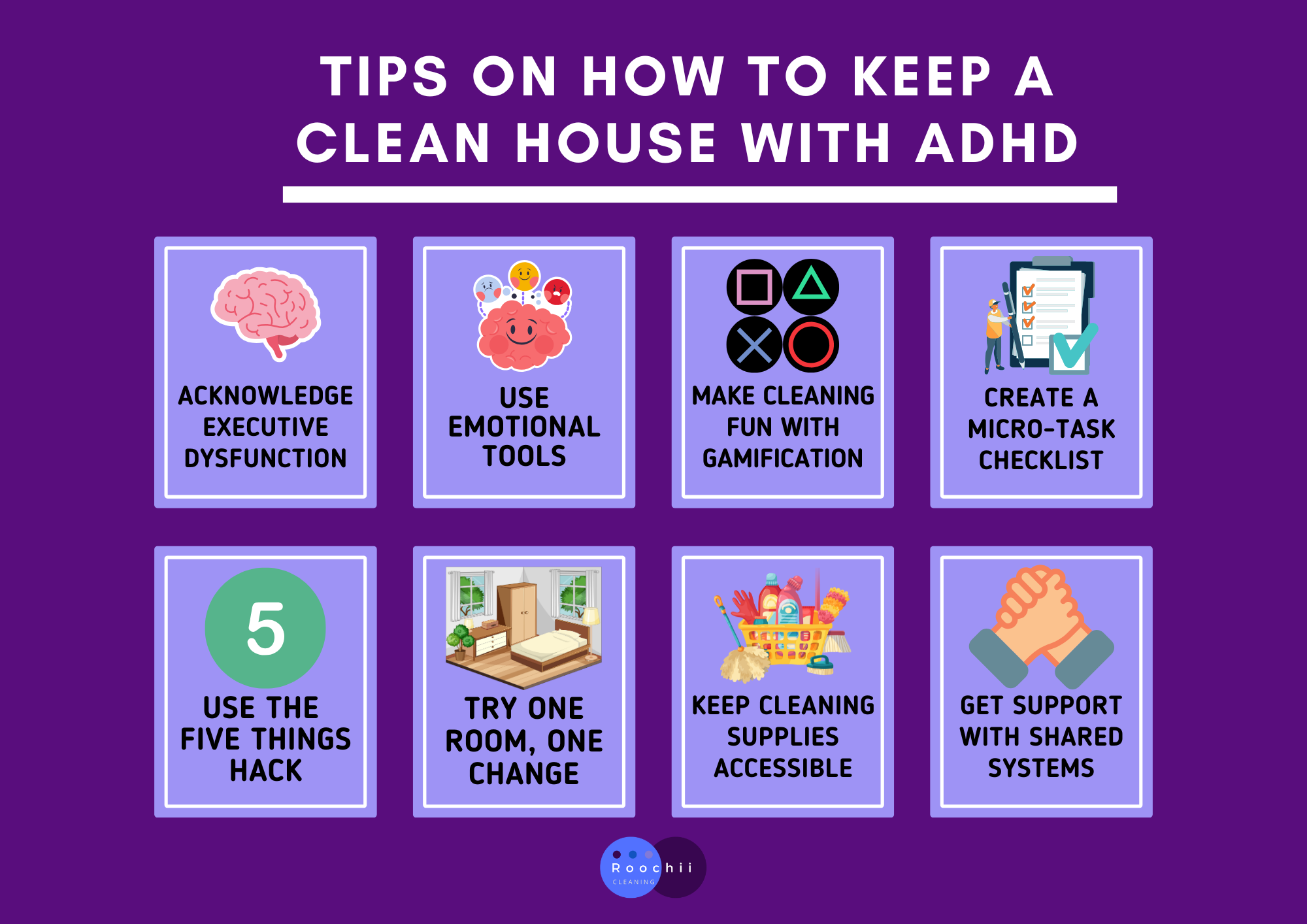
1. Acknowledge executive dysfunction
First and foremost: you are not lazy. Executive dysfunction is a neurological challenge that affects how your brain works.
It’s often present in conditions like ADHD, autism, depression, and anxiety, but even without a diagnosis, people can experience it during periods of stress or burnout.
Understanding executive dysfunction means recognizing that even when you know what needs to be done, starting or finishing that task can feel like climbing a mountain. Your brain’s wiring is simply out of sync with the task at hand.
Why it happens: Executive dysfunction affects the brain’s ability to start tasks, switch focus, and sustain effort. Instead of forcing yourself to work like everyone else, adjusting your environment and routines to fit how your brain works leads to more consistent progress, with less frustration and shame.
2. Address overwhelm with emotional tools
Overwhelm isn’t just about a messy space. It’s also the emotional weight behind it: shame, guilt, and mental exhaustion.
These feelings can paralyze you and lead to avoidance, which only makes things worse. You just never get to start cleaning.
This emotional paralysis can overlap with related struggles, such as cleaning with depression, where energy and motivation are already running low.
Instead of pushing through, pause and regulate. Use emotional tools that speak to your nervous system:
- Self-compassion: Remind yourself you’re not failing. You’re just navigating something you find hard, so be kind to yourself.
- Breathing exercises: Simple, slow breaths can help calm a frazzled nervous system.
- Body doubling: Having someone nearby, even over video chat, can ease the pressure of doing it alone.
- Accountability partners or buddy systems: Cleaning alongside someone, or just checking in, helps maintain momentum.
- Time tricks: Tell yourself, “Just 5 minutes.” Starting small often builds momentum.
3. Make cleaning fun with gamification
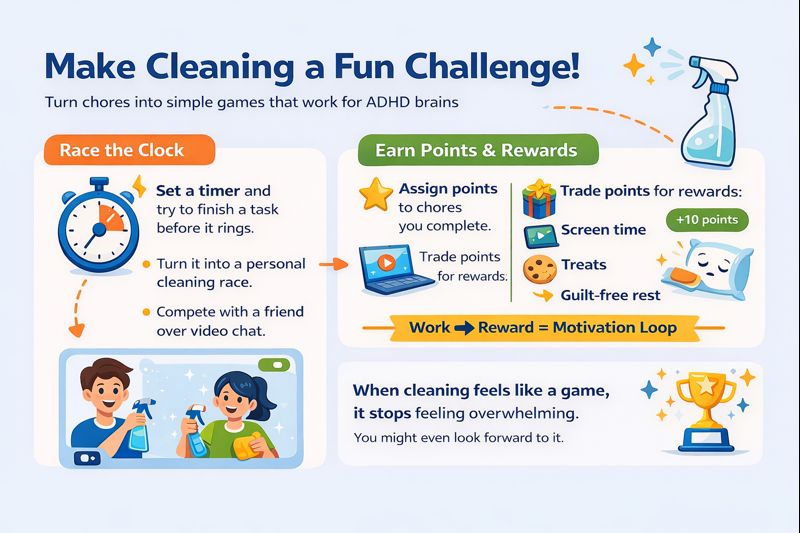
Cleaning shouldn’t and doesn’t have to feel like a punishment. It can be fun when you turn it into a game!
Neurocognitive studies continuously show that for ADHD brains, novelty and challenge are powerful tools to stay engaged, so gamifying your cleaning routine taps into both.
Start simple: set a timer and challenge yourself to finish a task before it goes off. Turn it into a personal cleaning race, or compete with a friend over video chat.
You can also use a reward system. Assign points to chores, then trade them in for something you love, like screen time, a treat, or a guilt-free nap. That’s the heart of creating a positive reinforcement loop: do the work, earn the win.
4. Create a micro-task cleaning checklist
Writing down “clean the bathroom” is setting yourself up for overwhelm. When your brain sees something vague and huge, it freezes.
The fix? Break everything down into tiny, doable actions. Think: “wipe the sink,” “scrub the toilet,” “empty the trash,” “refill soap.” Each micro-task is quick, clear, and satisfying to check off. This taps into a routine of small tasks that gives your brain direction and rewards it with a mini dopamine hit for each win.
Use a cleaning checklist or a physical chart. Whatever format makes the tasks visible and easy to follow for you.
“As a professional organizer and ADHD coach, I help clients break through the overwhelm and shame that can make tackling cleaning tasks feel impossible. ADHD isn’t a problem of knowing what to do—it’s doing what you know. Embrace the way your brain works and engage the supports you need to take action. By breaking big goals into approachable microsteps, you begin to build momentum, confidence, and a sustainable sense of progress,” Ann Pereira of Professional Organizer and ADHD Coach of House of Projects LLC quipped.
Bathroom Micro-Task Cleaning Checklist
|
Zone |
Task |
|
Sink & Counter |
|
|
Toilet |
|
|
Shower / Tub |
|
|
Floor & Finishing Zone |
|
5. Try the “Five Things” Hack to Get Unstuck
ADHD brains in particular can freeze where there’s no clear starting point.
This is where the “Five Things” Hack becomes helpful. It’s a quick, no-pressure way to get you moving without the stress of a full cleaning plan.
Look around your space and choose just one item from each of these categories:
- Something to throw away
- Something to put away
- Something to clean
- Something to donate
- Something that doesn’t belong here
These five small actions help reduce clutter, restore visual order, and boost your sense of control without demanding perfection.
To stay consistent, integrate this into your daily routine or build it into a cleaning schedule. Visual cues can also help ADHD brains stay focused and motivated.
You can also use the Five Things Hack as a warm-up before tackling a more structured task. It’s flexible, repeatable, and incredibly grounding. Pair it with your decluttering process, or add it to a cleaning chart with other prioritized zones or rooms.
6. Follow the “One Room, One Change” Strategy
When your space feels overwhelming, it’s easy to think you have to clean everything at once. But ADHD brains benefit from focus and simplicity.
That’s where the “One Room, One Change” strategy shines. Choose one room, and make just one meaningful improvement.
Clear off a counter. Vacuum the couch cushions. Clean one toilet. These aren’t huge projects. They are manageable actions that create visible impact.
Even one change can help shift your space toward a more functional home without requiring a full cleaning overhaul. And for ADHD brains, even a single shift in the visual landscape can feel like a major transformation.
You can fold this method into a daily routine, rotating rooms throughout the week or plugging it into your cleaning schedule. It also works great alongside the five things hack or during a slow-moving decluttering process.
7. Make cleaning equipment accessible
Out of sight, out of mind is practically the unofficial motto of ADHD brains everywhere.
If you don’t see it, you won’t remember it. Even if it’s something simple, like where the broom is.
Make sure to keep your cleaning tools visible and easy to grab. Store wipes, sprays, and trash bags in the rooms you actually use them, like under the bathroom sink, by the kitchen trash, or in a handy cleaning caddy you can carry around.
If it helps, you can use a physical chart to remind yourself what tools go where.
8. Get the Proper Support
You don’t have to do this alone. In fact, trying to manage everything solo can quickly lead to burnout, especially with ADHD, where motivation and follow-through can fluctuate daily.
You can always get the help of people around you.
It can look like involving roommates or family, or simply hiring a cleaning service like Roochii Cleaning. Any of these can lighten the load.
It’s all about creating a rhythm that works for you, with support that keeps you going. Doing it together makes it easier to keep going.
Organization Tools and Apps To Use for ADHD Cleaning
One of the best ways to support your cleaning routine with ADHD is by using the right tools: ones that reduce decision fatigue and keep you focused without overwhelming you.
The goal isn’t to “get it perfect,” but to build a support system that keeps you moving forward.
Here are some ADHD-friendly cleaning apps and tools to try:
A. Tody: Gamified ADHD-Friendly Schedule App
Tody helps turn cleaning into a game-like, customizable schedule.
Instead of nagging you with due dates, it shows you when a task is “due soon” based on your preferences. It’s perfect for ADHD brains that resist rigid structure.
B. Sweepy: Gamified Cleaning for ADHD Homes
Ideal if you want to gamify cleaning. Sweepy breaks chores into small, manageable chunks, tracks progress, and even lets you share tasks with household members. You get that satisfying sense of accomplishment with every win.
C. Todoist: Simple Cleaning Lists That Sync
Todoist is great for creating quick, straightforward task lists. Use it to brain-dump all your cleaning goals, then check them off one at a time.
Bonus: it syncs across devices and lets you schedule recurring tasks.
D. Trello or Notion: Visual Planners for ADHD
If you’re a visual thinker, Trello and Notion really shine. You can create cleaning boards, color-coded cards, or even build a dashboard for your entire routine. It’s perfect for those who love customizing their systems.
E. Alexa or Google Assistant: Voice Reminders for ADHD Cleaning
Some people with ADHD work better with voice reminders like Alexa or Google Assistant. They can be lifesavers.
Just say, “Remind me to clean the sink at 4 PM,” and let the tech do the remembering for you.
The key with all these tools? Don’t force it. Try a few, notice what feels intuitive, and ditch anything that starts to feel like a chore. Only use the ones that make cleaning enjoyable for you.
The best cleaning apps for ADHD are the ones that feel like helpful and not another to-do list to ignore, especially when figuring out how to clean when you have ADHD and need tools that actually support your focus and routine.
Final Thoughts: Your Clean Home is Possible
Cleaning with ADHD doesn’t have to feel impossible. You’re not doomed to clutter, chaos, or shame just because your brain works differently.
When you lean into strategies built for you, such as small tasks, visual cues, emotional support, and flexibility, you can build a home that feels functional and genuinely yours.
Progress may be messy. That’s okay. You don’t have to do it all today. You just have to start somewhere.
FAQ
FAQs on Keeping a Clean House with ADHD
ADHD affects executive functioning, making it harder to start, prioritize, and follow through on tasks.
Add time blindness and emotional overwhelm, and cleaning can feel like a mental marathon.
Yes. Most cleaning advice assumes linear thinking and sustained focus, which are things people with ADHD struggle with. ADHD cleaning needs to be flexible, rewarding, and paced.
Not at all! What matters is finding a rhythm that works for you, whether that’s daily, weekly, or somewhere in between.
Start small. One sock. One corner. One five-minute burst. Momentum builds from there. The win is in starting, not finishing everything.